
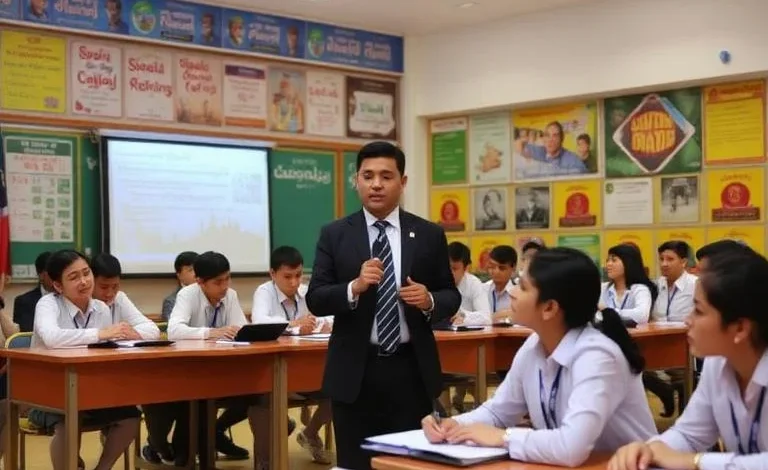
The effects of teacher hiring policies as a factor of school transformational leadership in Lahore

Task 1: Critical Evaluation of Research Sources
This mind map visually illustrates the key themes, theories, and methodologies that pertain to the topic of “The Effects of Teacher Hiring Policies as a Factor of School Transformational Leadership in Lahore.” It helps to support the critical discussion that follows.
Transformational Leadership Theory:
Transformational leadership, as conceptualized by Burns 1978 and elaborated by Bass 1985, stresses the importance of visionary leadership in inspiring, motivating and developing followers beyond transactional exchanges.
This theory has been very useful in educational contexts to understand how school leaders can promote innovation, commitment and professional growth among teaching staff. Transformational leadership differs from transactional leadership in that it promotes a shared school vision, encourages creativity, and addresses the emotional and developmental needs of teachers.
Idealized Influence, Individualized Consideration, Intellectual Stimulation, and Inspirational Motivation are the four components that Bass 1985 identifies as part of transformational leadership: serving as role models, providing personalized support, encouraging critical thinking and innovation, and inspiring a collective mission. These dimensions directly correspond with practices that enable teachers to make significant contributions to school improvement.
However, in countries such as Pakistan, structural challenges are encountered with the operationalization of transformational leadership. Transformational models, however, expect the most leadership roles in public schools to be merit-based rather than bureaucratically assigned, which limits the autonomy and vision that are expected in transformational models.
In addition, cultural norms often discourage the participatory and collaborative ethos that is at the heart of transformational leadership. However, empirical studies indicate the continued gap between theoretical ideals and institutional realities of South Asian school systems.
More context-specific adaptations of transformational leadership theory are needed, especially in developing regions like Lahore, where structural and political constraints play a very significant role in shaping leadership practice.
Teacher Hiring Policies & Governance in Pakistan:
In the past two decades, there has been a great deal of reform in teacher hiring policies in Pakistan, especially in the province of Punjab. Recruitment has historically been plagued by nepotism and political interference and was often centralized and opaque, which contributed to inefficiencies in school staffing. Several policy shifts were initiated under the Punjab Education Sector Reform Programme (PESRP), which was meant to improve transparency, meritocracy and decentralization in teacher recruitment.
However, despite these reforms, the hiring process remains largely centralized, especially in public schools, where teachers are placed without regard for local school needs or leadership vision. Such misalignment of school-based decision-making undermines the very core of transformational leadership. It is difficult for principals to have the autonomy to select staff and thus create cohesive teams that align with school goals.
In addition, the problem of merit vs. patronage continues. Since then, standardised recruitment exams were adopted to increase transparency of the procedure, however studies have shown that there are still cases of political influence and administrative loopholes allowing unqualified candidates to skip the merit-based process. Failing staffing, especially in rural and underserved areas, means teachers don’t appear or they hire inexperienced teachers or use temporary staffing.
The dynamics work against school transformational leadership implementing transformative change since staffing decisions are not aligned with strategic priorities but instead imposed externally. While policy reforms have been promising, structural barriers to transformational leadership in urban public schools of Lahore, such as the lack of school level hiring autonomy, continue to exist, especially when student populations are diverse and educational demands are high.
Empirical Studies in South Asian Contexts:
Recent empirical research in South Asia has shown that hiring policies intersect with school transformational leadership in a complex way, especially in the public sector education. As Akram and Khan demonstrated through a qualitative study of public schools in Punjab, despite formal mechanisms of merit-based hiring, systemic corruption and lack of transparency continue to impact teacher appointments. The findings suggest that many headteachers felt ‘disempowered’ to shape staff composition, and this manifested itself in inconsistencies in teacher commitment and performance.
In a broader mixed methods study of school transformational leadership in Pakistan, found that school climate and leadership effectiveness were directly affected by hiring practices. Where leaders had some say in staffing decisions, schools were more aligned between vision and practice.
Yet they observe that institutional norms and top-down governance constrain such autonomy. This is also echoed in comparative studies from India and Nepal, where there are similar problems of policy practice disconnect.
These studies provide useful contextual insights but are methodologically weak, with small, region specific samples or insufficient triangulation. Furthermore, the data is self reported, thus introducing bias. But a recurring theme is that school leaders’ ability to be effective leaders is not only limited by individual capacity but by structural hiring systems that prevent school leaders from recruiting or shaping their teaching teams.
These findings imply that leadership needs to be reconceptualized in the context of the broader political economy of South Asian education systems.
Leadership Practices Affected by Staffing Decisions:
The quality and coherence of a school leader’s teaching staff is intimately linked to the quality and coherence of the educational vision that the school leader can build and enact. As Bush 2020 asserts, leadership is not only about direction but also about assembling and sustaining the team to bring the direction to life.
Thus, the selection of teachers becomes a strategic act of leadership in this sense. If school leaders are unable to influence hiring, the misalignment between teacher capability and school goals can have a significant impact on the ability for transformational outcomes.
In resource-constrained settings (as exists in Lahore’s public schools) effective leaders make up for this by investing in staff development and encouraging collaboration. However, such strategies are more likely to be effective when leaders have first chosen teachers who are open to shared goals and innovation. In externally controlled hiring, leaders also struggle to create a unified school culture or inspire staff to improve.
Further, Spillane (2005) emphasizes the importance of trust and mutual competence among school staff in his concept of distributed leadership. Leaders struggle to identify and empower the right people to be distributed in leadership, without input into teacher selection. This leads to a cascade of reduced collaboration, low morale, and broken implementation of school wide initiatives.
Urban Lahore empirical data indicated that school headteachers’ hiring choices, predominantly in the private or semi autonomous school, enhanced staff cohesion and goal alignment among the school board. In contrast, schools with total control of the leadership felt the most disconnected between strategic intentions of leadership and classroom practice, which underscores policy level reconsideration of recruitment authority.
Methodological Approaches in Reviewed Studies:
Generally, the body of literature on educational leadership and teacher hiring in South Asia relies mainly on qualitative research methodology, with case studies and semi structured interviews taking up most of that body of literature. It is likely because educational leadership phenomena are contextual and interpretive and that rich, detailed data are needed to unravel complexities of culture, power, and institutional norms.
An example of the latter is studies such as Akram & Khan were strongly dependent on interviews with school leaders, delivering rich understandings concerning the experience of powerlessness in hiring processes. Unfortunately, however, this tends to limit the applicability of such approaches to small samples and to the generalisability of findings across the many different educational landscapes.
Less frequently used but providing value are the quantitative methods (e.g., large-scale surveys, policy impact assessments) for revealing systemic trends. For example, broader validity is offered by using provincial education data to demonstrate disparities in teacher allocation. While there are limitations to quantitative studies in explaining why such disparities exist, such problems are not a common shortcoming in the qualitative work.
To bridge these gaps, some researchers employ mixed methods approaches, combining statistical analysis with qualitative narratives. A study argues that such triangulation can improve both the credibility and transferability of findings in complex social research contexts such as education reform.
All methods have crucial ethical considerations, especially concerning consent, confidentiality and the power of social hierarchies in interviews. Teachers and leaders in Pakistan’s hierarchical education system may hesitate to speak candidly, thus leading to data authenticity.
In the end, methodological pluralism, combined with contextual sensitivity, is necessary for creating reliable, relevant research in this field.
Conclusion:
The reviewed literature indicates that there is a consistent tension between the principles of transformational leadership and the structural constraints of centralised, politicised hiring policies in Pakistan. Despite the compelling vision of visionary, people centred leadership offered by Bass and Leithwood’s theories, empirical research in South Asia reveals that the realities of school leaders’ autonomy in staff selection are limited, which is a key driver of school transformation.
The dominance of qualitative approaches, however, offers rich, if narrow, insight, methodologically. With clear gaps to begin to address, your portfolio will begin to fill in the lack of large scale, cross regional studies and the persistent marginalization of leadership voice in hiring systems.
Task 2: Research Strategies for Data Collection
The focus of this research is on the effects of teacher hiring policies as a factor of school transformational leadership in Lahore, specifically on how recruitment processes influence leadership capacity in public secondary schools. Teacher recruitment in Pakistan, and in particular Punjab, continues to be highly centralised, and competes with school leaders’ ability to create cohesive high performing teaching teams.
However, implementation gaps continue even with policy reforms under initiatives such as the Punjab Education Sector Reform Programme (PESRP), as there are reports of political interference, delayed postings and merit violations.
Yet education policy promotes transformational leadership as focusing on vision building, teacher and empowering, and innovation but remains elusive in contexts where school leaders have limited staffing autonomy. This disconnect is important for understanding the alignment of policy and practice with urban schools in Pakistan and the leadership effectiveness.
Main Research Question:
How do teacher hiring policies influence the implementation of transformational leadership practices in public secondary schools in Lahore?
Sub-questions:
- What level of autonomy do school leaders have in teacher selection?
- How do recruitment outcomes affect school leaders’ capacity to enact transformational change?
Justification for Research Approach:
The research adopted in this study is interpretivist in nature and is appropriate for explaining how people make sense of complex social processes in their institutional and cultural contexts. A contextualized, value and lived experience-based approach is needed to the central research focus, which is to investigate the influence of teacher hiring policies on transformational leadership. Interpretivism is useful for looking at how school leaders negotiate, adjust to or resist systemic constraints within a centralised bureaucratic structure.
Thus, a qualitative approach has been chosen as it allows for the exploration of perceptions, motivations, and meanings that underpin leadership practices in relation to staffing.
While quantitative methods can effectively identify patterns or correlations, they would lack sufficient ability to capture the fine, qualitative dynamics that frequently drive leadership response in such a policy driven environment.
The study does not use original quantitative data collection, but will use the findings from previous quantitative research to inform the analysis and interpretation. This is an acknowledgment of methodological pluralism that permits depth and breadth of understanding. The chosen approach is that leadership is not studied in isolation but in relation to the structural, political, and relational factors that shape it.
Data Collection Strategies:
Semi-Structured Interviews:
The primary means of data collection will be semi structured interviews with educators which will allow the gathering of detailed and context particular insights from educational leaders. The target participants are 6–10 school principals and senior staff of public secondary schools in Lahore who are directly involved in, or affected by, teacher recruitment processes.
The reason for the choice of this method is that it allows for consistency in themes and flexibility in responses. Questions will be pre determined on areas such as recruitment practices, leadership autonomy and school culture. Nevertheless, participants will be invited to elaborate on experiences and perceptions that are not directly prompted, thereby providing richer and more authentic data.
Interview themes will include:
- Autonomy in staffing decisions
- Perceptions of fairness and transparency in recruitment
- Impacts of hiring on teacher motivation and alignment with school goals
- Challenges in enacting a transformational leadership vision
Sample interview question:
“To what extent are you involved in selecting your teaching staff, and how does this impact your ability to lead effectively?”
Thematic analysis will be used to code the data, which will be audio recorded and transcribed. The purpose is to produce thick descriptions of leadership experiences in schools and to identify repetitions and divergences in these experiences across schools.
Document Analysis:
Key policy texts and procedural guidelines for teacher hiring will be analyzed as part of document analysis to complement the interviews. These include:
- Punjab Education Sector Reform Programme (PESRP) reports
- Government of Punjab’s Teacher Recruitment Rules (latest version)
- Official job postings, selection criteria, and placement policies
The qualitative data are given contextual depth and policy grounding for comparison with what the policies intend and how they are interpreted or enacted at the school level. Bryman highlights that document analysis is a useful method for understanding organizational intent, institutional culture and the gap between formal rules and practice.
The research can also triangulate its findings by examining recruitment criteria, appointment timelines, and role descriptions to identify there are systemic enablers or blockers for leadership efficacy. For instance, an analysis of appointment letters and timetables may indicate patterns of delays or lack of consistency with claims by interviewees that there are bureaucratic hurdles in deployment of teachers.
Sampling Strategy:
In this study, a purposive sampling approach will be used to select participants who are experts and have direct experience with teacher hiring and school leadership. It includes public secondary school principals, senior teachers and local education officers in selected areas of Lahore.
This study is exploratory qualitative study and thus it focuses on information rich cases as opposed to statistical representativeness.
A manageable and sufficient sample of 6–10 interviewees is proposed because it will yield data saturation, where recurring themes will emerge, while remaining feasible within the project’s time and ethical constraints. Length of leadership experience, involvement in recruitment processes and school type will be selection criteria.
Participants will come from a mix of:
- Urban and peri-urban areas
- Single-gender and co-educational schools
- Schools with high vs. low teacher turnover
The purposive sampling is well aligned with the interpretivist aim of discovering context-specific experiences and systemic patterns, and although it limits generalisability, it is an appropriate approach. Cohen, Manion, and Morrison suggest that this is a particularly appropriate method for studies of institutional and leadership dynamics in educational research.
Ethical Considerations:
This study is based on ethical integrity. Data collection will be done after all participants are informed of the voluntary nature of their involvement and written informed consent is obtained. They will be assured that they have the right to withdraw at any time without consequence. All transcripts and published data will be published with pseudonyms to protect identities, and the interview recordings will be stored securely in encrypted digital formats.
As hiring practices and transformational leadership challenges are so sensitive, power dynamics will be given particular attention. This might make school leaders reluctant to criticize institutional practices or expose systemic weaknesses.
This will be mitigated by conducting interviews in private settings and reminding participants that data will be anonymized and will not be shared with superiors or education departments.
The University of Bolton’s research ethics policy will be fully complied with, including formal ethical approval through the university’s review process. The design will also be guided by ethical guidelines established by BERA to safeguard dignity and confidentiality of all the participants involved.
Trustworthiness and Rigour:
This study will apply Lincoln and Guba’s trustworthiness criteria of credibility, transferability, dependability, and confirmability to ensure that research quality.
Member checking will be used to support credibility through inviting participants to review their interview transcripts for accuracy and interpretation. Informal peer debriefing with academic supervisors and other researchers will also assist in refining themes and questioning of assumptions during analysis.
Thick descriptions of school contexts, participant backgrounds and institutional settings are provided to enhance transferability by allowing readers to decide how the findings might apply to similar educational settings, especially in urban South Asian settings.
The maintenance of an audit trail, recording methodological decisions, coding schemes and analytic memos will be used to address dependability. It will allow others to follow the research process and check the consistency of the findings.
The confirmation of objectivity will be maintained through reflection on researcher positionality and limiting personal bias by transparent documentation of analytic choices. According to, qualitative rigour is not determined by neutrality but rather by methodical transparency, reflexivity and evidence-based interpretation.
Potential Limitations and Challenges:
This research design, however, has its limitations. Logistical challenges may exist in gaining access to school leaders through administrative gatekeeping and busy school schedules. Trust is also gained, particularly in talking about potentially sensitive topics such as hiring fairness, which may affect the depth and honesty of participant responses.
Also, education data in Punjab is under centralised control, thus limiting access to recruitment records and official documentation, which may limit the scope of document analysis.
Such interplay among language and culture, as well as changes in participant responses may be affected by the interviewer’s perceived academic or institutional authority. Additionally, findings cannot be generalized but can be insightful for analogous contexts, given the small, non-random sample. However, the chosen, qualitative approach eliminates these limitations by offering depth and richness.
Conclusion:
This section has presented a contextually grounded, ethically sound research strategy for studying the effects of teacher hiring policies on transformational leadership in Lahore. The interpretivist qualitative approach of semi-structured interviews and document analysis allows for deep engagement with both individual experiences and policy structures.
The study is credible and relevant because of purposeful sampling and rigorous ethical safeguards. While there are challenges of access and generalisability, the methodology is still fit for purpose in capturing the complex, context-bound realities of educational leadership in a constrained bureaucratic environment. The strategy is a strong base for answering the research question and informing future policy and practice.
Task 3: Comparative Case Study
In educational research where the issue to be investigated is complex and often context-specific like teacher hiring and school leadership, it is important for other studies to be compared. Methodological diversity enables researchers to examine the statistical pattern as well as lived experiences to build a holistic understanding of how systemic challenges are experienced and the stakeholder perspectives.
In this case study, two separate but complementary studies about the intersection between teacher recruitment policies and transformational leadership in public education systems are compared. The first employs a qualitative case study approach to explore the constraints school leaders face in Punjab, Pakistan. The second employs quantitative survey methods to determine if recruitment efficiency is linked to school performance metrics.
The insights are triangulated through an additional study which also reflects on methodological strengths and limitations.
Overview of Study A: Qualitative Case Study
In the qualitative case study “Transformational Leadership and management in public schools: Opportunities and challenges faced by school leaders in Punjab” explored the leadership constraints in public sector schools.
The study located the study within Pakistan’s largest province and sought to understand how bureaucratic hiring systems impact the capacity of school leaders to utilize effective leadership practices, in particular those consistent with transformational models.
A constructivist interpretivist paradigm was adopted by the researchers and semi structured interviews were conducted with ten secondary school principals in different districts of Punjab. Thematic coding was used to analyse data, to identify recurring patterns and individual variations.
The central research question of the study was: How do teacher hiring policies affect the leadership capacity of school heads in the public education sector?
Participants expressed a clear disempowerment. The teaching staff selection was outside of the control of principals, with appointments often being misaligned with the school’s vision, values or development needs. Some of them mentioned cases where political interference led to the assignment of under qualified or unwilling teachers, which affected the school culture and hampered transformational initiatives.
The strengths of the study are that it is able to provide rich, context specific insights into leadership realities. It gives voice to principals who reveal the disconnect between centralised recruitment and the local leadership needs.
Its limitations include small sample size, which limits generalisability and subjective nature of the data, which can be shaped by participant bias or social desirability. However, the depth of understanding that this study offers to leadership research in the Global South is a valuable contribution.
Overview of Study B: Quantitative Study
In “Better teachers, better results? Evidence from rural Pakistan”, conduct a large-scale quantitative study to examine the impact of systemic factors in teacher hiring on leadership efficacy and school performance across public secondary schools. The study had a positivist paradigm and statistical analysis of survey data collected from more than 150 school leaders and administrators in Lahore and adjacent districts.
The study measured variables such as timing adherence to recruitment, transparency of policies, teacher retention rates, and analysed the effectiveness of perceived leadership. Correlation analysis and linear regression models were used to analysis data to identify statistically significant relationships between recruitment processes and school level outcomes.
The key findings of the study showed a strong negative correlation between recruitment delays and leadership ratings, which implies that delayed postings disrupt school planning, continuity, and lower morale of leaders.
In addition, schools more transparent about the criteria of hiring policies, or providing criteria and communication to hiring, had teachers retained better, and were more aligned with leadership goals as well. The implications of these findings for the argument that systemic inefficiencies in recruitment directly constrain school leaders’ ability to implement strategic change are supported.
The strengths of the study are that it is large and diverse, thereby permitting a degree of generalisation that would not be possible in small scale qualitative studies. The statistical rigour of the findings lends validity and replicability to the findings and therefore they are relevant for policy-level decision-making.
The study’s limitations are the lack of depth in how experiences or contextual influences are interpreted. Trends are captured but the subjective effects of policy constraints on the people are not explored. A study argues that quantitative approaches rarely shine a light on the nuanced process of leadership under restraint and so they fail to tease out some of the more complex ways in which humans understand their own lives.
Comparative Analysis: Key Themes Across Studies
Theme 1: Leadership Autonomy
The studies agree that leadership autonomy is important in staff recruitment, but they do so from different perspectives. Study A offers qualitative evidence that school principals feel disempowered and excluded from the hiring processes. The analysis of the theme reveals frustration and helplessness when external authorities assign unsuitable teachers, which undermines school improvement plans.
However, Study B measures this problem by demonstrating a statistical relationship between recruitment autonomy and leadership performance scores. Principals who were able to exert more influence over staff appointments also gave themselves higher ratings on their ability to lead effectively. The qualitative study gives depth of perception, the quantitative study gives evidence of prevalence.
Theme 2: Recruitment Practices & School Culture
Study A exposes the embedded cultural problem of patronage, where leaders refer to politically motivated appointments that broke up the team. This is consistent with research that shows patronage still influences staffing of public service in Pakistan despite formal policy reforms.
While Study B does not address patronage directly, it does provide macro level data that lack of transparency in recruitment is related to higher teacher turnover and lower school morale. It supplements Study A with systemic patterns on which the qualitative personal testimonies rest.
Theme 3: Methodological Influence
The contributions of the two studies are very much dependent on the methodological contrast between them. The qualitative nature of study A permits rich and located accounts of experience. The second part of it captures the emotional strain and professional conflict that comes from centralised hiring, particularly for leaders who are trying to drive a transformational vision.
Quantitative approach of study B helps to find a broad picture and to be used in policy advocacy and the systemic reform discussions. Still, it does not offer any understanding of how those policies are experienced, negotiated, or resisted at the school level.
Different methods have different realities. Quantitative research offers scale and objectivity, but qualitative means add depth, the nuance, and the context (the importance of this cannot be overstated given the complex and contextual educational environments viewed through the lens of culture, politics, wrongdoing interpersonal).
Synthesis with a Third Mixed-Methods Study
In a comprehensive mixed methods study, “School Leaders’ Perspectives on Successful Leadership: A Mixed Methods Case Study of a Private School Network in Pakistan” examined the impact of system level constraints (staffing and recruitment policies) on school leadership practices. Quantitative survey data from 72 schools in three provinces, including Punjab, were integrated with in depth interviews, focus groups and policy document analysis.
This enabled the researchers to triangulate: finding quantitative trends validated by qualitative narratives. For example, some statistical data showed that schools with greater faculty selection had improved pupil outcomes. Interview data surrounding school leaders who influenced hiring decisions also found that these same school leaders also created more cohesive and motivated teaching teams. Document analysis of hiring protocols is also used to show a gap between policy intent and what takes place on the ground.
The strength of the mixed methods approach is that it can close the gap between macro level patterns and micro level experiences. Where as quantitative research has limited scope, qualitative research has interpretive depth, and the first compensates for the limited scope of the second. However, it is resource intensive requiring time, technical skill and coordination to deal with wide ranges of data types.
Yet, despite the difficulties inherent with such research, show the analytical richness and policy relevance that a mixed methods approach can offer in research like this involving complex institutional dynamics like teacher hiring and school leadership.
Implications for Your Own Research Strategy:
The comparison of these studies strongly suggests that this research on transformational leadership and teacher hiring in Lahore would best be conducted with a qualitative dominant or mixed methods approach. Quantitative data helps us identify system wide patterns, but the core of research question is how leaders process and respond to policy constraint, something that interviews and document analyses do better than other materials.
This also means that this study must be careful about researcher bias and should be as rigorous as possible in coding and triangulation to maintain credibility. There are access challenges, especially when scheduling interviews with school leaders or obtaining sensitive hiring documents. It will be important to ensure ethical transparency and respect participants’ positions in hierarchical structures.
Conclusion:
This comparative case study has shown the different contributions and limitations of the qualitative, quantitative and mixed methods research in studying the issue of teacher hiring and leadership in Pakistan. Both offered rich, experiential insight into school leadership constraints andoffered generalizable, policy-relevant findings through statistical analysis. showed the power of triangulation to bridge micro and macro level understandings using the mixed methods study.
Taken together, these studies highlight the importance of methodological diversity in education research, and especially so in research on topics centred on bureaucracy, culture, and leadership dynamics. However, each method provides a different view on the problem and together they provide a more complete picture.
Reflective Statement
The Research Design and Methods module has redefined my understanding of research as a process that involves more than a procedural or technical exercise. At first, I thought it was a question of collecting data and following guidelines, but the module has reoriented it as a contextual, ethical and political practice. It became particularly apparent as I worked on my own research proposal on teacher hiring and transformational leadership in Lahore, something I am both academically invested in and personally familiar with.
It was really this shift that took hold when I began focusing my own research on the question of how teacher hiring policies affect transformational leadership in Lahore. It was a topic close to home, and that’s why it was important to look at it critically.
I came in very much evidence based, very much measurable research, but the interpretivist lens sort of challenged that. I found its subjectivity to be at first. It was uncomfortable to admit that experience, perception, and meaning making could be on par with statistics. However, readings from Cohen et al and Creswell helped me realize that when researching something as complex and personal as leadership, the personal and subjective are not distractions, they are necessary. That insight motivated me to move to qualitative methods, specifically interviews and document analysis, since this topic requires such depth and nuance.
However, planning research on such a politically charged and administratively rigid issue wasn’t easy. In Task 3, I noticed how much the method you choose dictates the knowledge you produce when comparing different studies.
Akram & Khan provided powerful accounts of how headteachers feel constrained but missed the bigger picture of the policy. However, on the other hand, de Talancé provided the broader overview, but failed to capture the lived experiences behind the numbers. When I compared that, I realised that every method is a lens, it shows some things and hides other things. That includes my own lens as a researcher. That was uncomfortable to admit, but it had to be.
Staying rigorous while also accepting complexity of context was one of the biggest tensions I had. Lincoln and Guba’s work on trustworthiness really shook my thinking about the quality of research. Their criteria for credibility, dependability, confirmability and transferability are not simply ticks in boxes. They have more to do with honesty, transparency and accountability in how you collect and analyse data.
As I got into those audits’ trails and reflexive journaling, I realized that they were more than admin task, they were really ways that I am helping me to stay steeped in the thoughtfulness of the research process.
Ethics too became a new dimension. At first, I thought of ethics as mostly forms and consent sheets. I began to realize that trust, power, and positionality are ethical concerns, not only procedural ones, but when I started envisioning a path toward interviewing school leaders, who live and work in environments shaped by hierarchy and surveillance.
Taking a cue from Shah and the module’s lecture on the Ethics of Care, I began to think about how I, as a researcher, might be perceived, and whether or not that perception would influence what participants were willing (or able) to share. That was when I forced myself to reconsider my interview strategy around how I ask question structure, my assurances that participants felt as safe, respected and genuinely heard.
My relationship, too, with transformational leadership theory grew. In the beginning I had taken it on as a blueprint for effective school leadership, I had seen it through the lens of Bass and Leithwood. However, by the critical framing of the module, I began to realize the limitations of this model when applied without any criticality to the South Asian context.
However, it became clear that the theories that are in place in Western settings might not necessarily hold in system setups such as Pakistan’s, where for example hiring is frequently politically influenced and leadership is restricted on bureaucracy. This made me stop seeing theory as the truth and see it as something that can be questioned, adapted to or resisted.
The Padlet discussions and peer reviews were difficult but useful group activities. I was exposed to methods I had never seriously considered (participatory action research, ethnography) and realised how fast I was rejecting approaches that did not look like how research should be. At the same time, I observed that I was also prone to over defending qualitative methods a bit too much, perhaps out of insecurity, and underestimating the merits of the quantitative ones.
The peer feedback came at a good time in my life to make me more balanced and to remind me that no method is inherently better, it’s about fitness for purpose.
The most difficult, and valuable, lesson from this module was to accept uncertainty. Coming into the programme, I had hoped to find clear answers, and I leave this module with better questions. The growth is that shift from looking for solutions to being willing to explore complexity. It’s also changed how I view leadership, not as a list of best practices, but as something dynamic, contested, and deeply context driven.
I know there is still work to do looking ahead. I have to improve my data analysis skills, especially in coding qualitative data and mixing it with policy analysis. I want to expand my methodological range to possibly using mixed methods in the future or using visual and digital tools to share research in a better way.
I also want to improve my confidence about how to write critically (to connect theory or data in ways that are rigorous and reflective). To do this, I will keep a reflective journal throughout my dissertation project and seek out feedback early and often.
This module not only teaches me how to design research. It has taught me how to think about knowledge, ethics and what it means to be a responsible researcher. Not only have I gotten a set of tools, but I’ve come away with a way of thinking that is more critical, more aware, and more tuned in to the messiness of educational research. It’s something I’ll be carrying with me long after the assignment is submitted.