

Project Plan for Redesigned Annual Report at the Not-for-Profit Medical Research Center

This report “Project Plan for Redesigned Annual Report at the Not-for-Profit Medical Research Center”, Known for its work on aging-related diseases, the not-for-profit medical research centre depends heavily on public funding and donor support.
Its redesigned annual report has historically been an internal record presented in a text-heavy, monochromatic format. However, what is unique is the board’s decision to upscale the report into a vibrant, stakeholder-oriented marketing tool, a strategic move to enhance the brand and engage donors.
The purpose of this transformation is to create a compelling document that communicates the centre’s research impact, financial integrity, and social value to existing and potential donors. By integrating testimonials, visual narratives, and accessible language, the upgraded report aims to evoke an emotional and intellectual response from readers.
Strategic project planning in a not-for-profit context is crucial for balancing limited resources with high-impact outcomes. Effective planning ensures transparency, cost-efficiency, and alignment with broader institutional goals, particularly when communicating with diverse stakeholders.
Read more: Advanced Project Management of the Climeworks
Project Objective & Assumptions
Project Objective:
The project objective aligns with the Project Integration Management and Scope Management knowledge areas defined in the PMBOK® Guide, ensuring all objectives, deliverables, and constraints are documented and controlled.
The SMART criteria used in defining the project objective reflect standard goal-setting frameworks that support clarity and accountability in planning. By grounding the plan in these established principles, the team ensures it can measure performance against well-defined targets.
- Specific: Create a full-colour, image-rich annual report tailored for stakeholder engagement.
- Measurable: Print and mail 5 million copies to donors and key stakeholders.
- Achievable: Utilize a dedicated team of four external vendors and a detailed plan.
- Relevant: Align with the board’s directive to enhance fundraising appeal.
- Time-bound: Complete production and distribution by November 15.
Assumptions:
- Financial data will be finalized and available by October 15.
- Non-financial content collection can begin immediately after board approval on May 15.
- All internal team members will be available throughout the project period.
- External vendors (e.g., design, print, mail) will be sourced and contracted on time.
- Necessary approvals (budget, content, layout) will be obtained without major delays.
- Travel arrangements to medical facilities for testimonials will be feasible within budget.
- All stakeholder contact databases are up-to-date and accessible for distribution.
Work Breakdown Structure (WBS) & Activities
Work Breakdown Structure:
The Work Breakdown Structure (WBS) was developed by PMBOK’s Scope Management processes, which recommend decomposing project deliverables into smaller, manageable components. This facilitates accurate cost and time estimation while supporting resource assignment and risk identification. A well-structured WBS also serves as a foundation for controlling project scope and avoiding scope creep during execution.
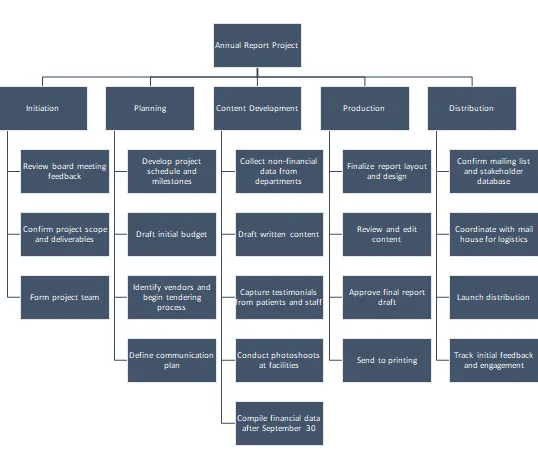
This structured approach ensures that the workload is manageable, that all necessary activities are captured, and that dependencies between tasks are identified. The WBS supports both scheduling and cost estimation, essential to gaining board approval and managing the project within constraints.
Specific Activities:
Initiation
- Review feedback and expectations from the board meeting
- Define project scope, goals, and deliverables
- Assign internal project roles (Alexis, Grace, Levi, Assistant)
- Conduct a stakeholder needs analysis
Planning:
- Create a detailed project schedule (timeline, milestones, dependencies)
- Draft a preliminary project budget for board review
- Identify external vendors for design, printing, and mailing
- Issue Requests for Proposal (RFPs) and collect bids
- Develop an internal communication and coordination plan
Content Development:
- Request non-financial updates from research departments
- Collect success stories and testimonials from patients and families
- Schedule and conduct photography sessions at partner medical facilities
- Write report content (research highlights, impact summaries, donor recognition)
- Liaise with the finance department to collect audited financial data (after Sept 30)
- Edit and review all content for clarity and tone
Production:
- Collaborate with the graphic designer to create the layout and visual theme
- Approve report drafts in collaboration with stakeholders
- Final proofreading and quality checks
- Submit finalized files to the printing vendor
Distribution:
- Update and verify donor/stakeholder mailing database
- Coordinate mailing logistics with the fulfillment vendor
- Schedule and track mail drops to ensure delivery before the holiday season
- Monitor stakeholder feedback and record insights for future reports
Responsibility Assignment & Network Diagram
Assignments:
Clear responsibility allocation is essential for task ownership, accountability, and effective execution. Based on the project scope, the following assignments are proposed:
- Alexis (Project Manager): Project planning, stakeholder coordination, vendor negotiations, budget management, and final approvals.
- Grace (Marketing Specialist): Report design oversight, content structure, visual branding, stakeholder messaging, and feedback tracking.
- Levi (Writer/Editor): Drafting all written content, integrating testimonials, ensuring tone and readability, and proofreading.
- Assistant (Photographer/Support): Organizing and conducting photography sessions, managing travel arrangements, supporting data collection.
This team structure leverages individual strengths while maintaining efficient collaboration across phases.
Network Diagram:
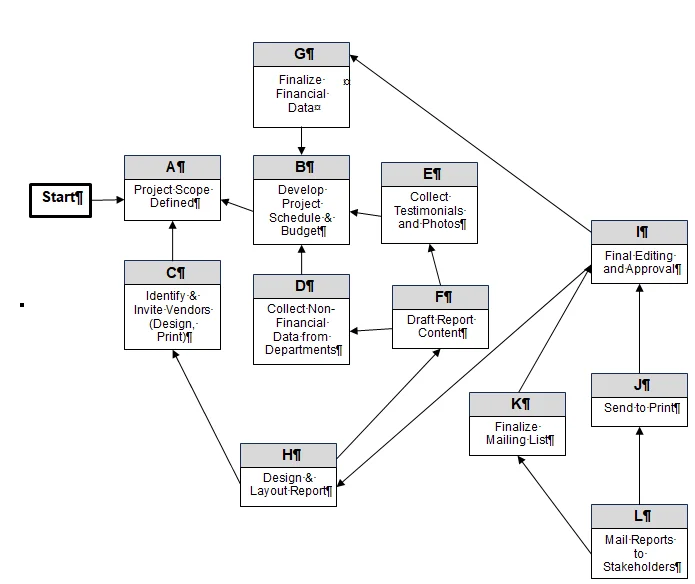
Activity Durations & Schedule Analysis
An essential part of effective project management is estimating the time needed for each task and calculating how the activities relate to one another over the life of the project.
For this redesigned annual report project, we applied the Critical Path Method (CPM) to determine when each activity can start and finish, as well as where there is flexibility (slack) in the schedule.
We assigned estimated durations to each activity based on task complexity and resource availability. Using a start date of Day 0 (May 15) and a required completion by Day 180, we calculated:
- Early Start (ES): Earliest time an activity can begin
- Early Finish (EF): ES + Duration
- Late Finish (LF): The Latest time an activity can finish without delaying the project
- Late Start (LS): LF − Duration
- Slack: The amount of time an activity can be delayed without affecting the final deadline
This analysis helps identify the critical path, which includes all activities with zero slack. These are the tasks that directly affect the project’s finish date.
Table 1 Activity Duration and Schedule Analysis Table
| Task | Description | Duration | ES | EF | LS | LF | Slack |
| A | Project Scope Defined | 5 | 0 | 5 | 0 | 5 | 0 |
| B | Schedule & Budget | 6 | 5 | 11 | 5 | 11 | 0 |
| C | Invite Vendors | 8 | 5 | 13 | 25 | 33 | 20 |
| D | Collect Data | 12 | 11 | 23 | 11 | 23 | 0 |
| E | Testimonials & Photos | 15 | 11 | 26 | 11 | 26 | 0 |
| F | Draft Content | 10 | 26 | 36 | 26 | 36 | 0 |
| G | Finalize Financials | 10 | 11 | 21 | 36 | 46 | 25 |
| H | Design & Layout | 14 | 36 | 50 | 36 | 50 | 0 |
| I | Editing & Approval | 7 | 50 | 57 | 50 | 57 | 0 |
| J | Send to Print | 5 | 57 | 62 | 57 | 62 | 0 |
| K | Finalize Mailing List | 4 | 57 | 61 | 62 | 66 | 5 |
| L | Mail Reports | 7 | 62 | 69 | 66 | 73 | 4 |
From this analysis, the critical path runs through:
A → B → D → E → F → H → I → J, totaling 62 days.
All other activities have slack, meaning they can be rescheduled without delaying the project.
This analysis ensures that project milestones are met and that attention is focused where it matters most.
Critical Path & Gantt Chart
Critical Path:
The critical path refers to the longest sequence of dependent activities that determines the shortest time possible to complete the project. Any delay in these tasks will directly delay the entire project.
For the Annual Report Project, the critical path was identified through schedule analysis using the Critical Path Method (CPM). The path is:
A → B → D → E → F → H → I → J
These tasks are critical because they have zero slack—they cannot be delayed without affecting the final delivery date of November 15. Project managers must monitor these tasks closely to ensure on-time completion.
Gantt Chart:
A Gantt chart is a visual scheduling tool that displays activities along a timeline. It clearly shows task durations, start and end dates, and overlapping or sequential work. Below is a Gantt chart based on the Early Start (ES) and Early Finish (EF) times for all activities.
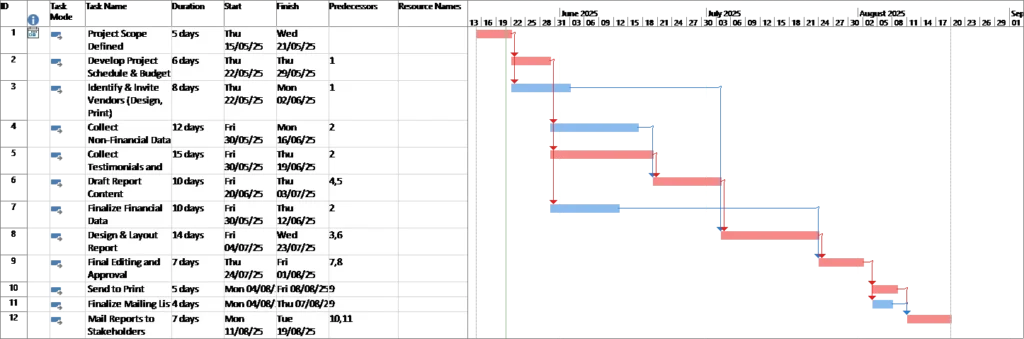
The Gantt chart shown below was created using Microsoft Project and represents the full project schedule from May 15, 2025, to August 19, 2025. It visually maps all project tasks along a calendar timeline, reflecting their durations, dependencies, and criticality.
Critical tasks are displayed in red, indicating that these activities have zero slack and must be completed on time to avoid project delays. In contrast, non-critical tasks, such as “Finalize Financial Data” and “Finalize Mailing List,” appear in blue and have built-in flexibility (slack), allowing for some delay without affecting the overall timeline.
This Gantt chart helps the project team clearly understand task overlap, sequencing, and resource prioritization. It supports effective monitoring of progress and early detection of risks, especially around critical path activities.
Project Budget
A well-structured budget is essential to gain board approval and ensure the successful delivery of the annual report project. Cost estimates have been calculated based on realistic industry rates for personnel effort, contractor services, and travel expenses. The proposed budget reflects the scope, duration, and quality expectations of the project.
Personnel Costs:
The internal team comprises four members: Alexis (Project Manager), Grace (Marketing Specialist), Levi (Writer/Editor), and the Assistant (Photographer). Costs are based on an average internal rate of $400 per day, estimated over the working days for each task.
Contractor Costs:
External services are needed for design, high-volume printing (5 million copies), and professional mailing. Quotes are based on average market rates and vendor estimates.
Travel Costs:
Field visits to three facilities (flights, accommodation, transport) for testimonials and photography are included under travel expenses.
Table 2 Project Budget Breakdown
| Category | Estimated Cost (AUD) |
| Personnel Costs | |
| – Project Management (Alexis) – 30 days x $400 | $12,000 |
| – Marketing/Design Oversight (Grace) – 20 days | $8,000 |
| – Writing/Editing (Levi) – 25 days | $10,000 |
| – Photography/Admin (Assistant) – 20 days | $8,000 |
| Contractor Services | |
| – Report Design (Freelance) | $6,000 |
| – Printing (5 million copies @ $0.20 each) | $1,000,000 |
| – Mailing Services (bulk distribution) | $150,000 |
| Travel Costs (3 field trips) | $9,000 |
| Contingency Reserve (5%) | $59,150 |
| Total Estimated Budget | $1,262,150 |
This budget aligns with the project’s scale and strategic goals and includes a 5% contingency to manage unforeseen issues, ensuring smooth execution and accountability.
Risk Assessment & Mitigation Plan
Every project carries uncertainties, and effective project management requires anticipating risks and preparing solutions in advance.
For this redesigned annual report initiative, several risks could impact the delivery timeline, cost efficiency, and overall quality if not properly addressed. By applying risk management principles, the project team can reduce exposure to potential delays and ensure stakeholder expectations are met.
The table below outlines four key risks identified based on their relevance to the project’s critical path, contractor dependencies, and information flow. For each risk, the likelihood and impact are assessed and a practical mitigation or response plan is developed to reduce potential disruption.
Table 3 Risk Assessment Matrix
| Risk Description | Likelihood | Impact | Mitigation / Response Plan | Justification |
| Delay in receiving final financial statements | Medium | High | Communicate deadlines early with the finance department; use placeholder figures to draft sections ahead of time. | Financial statements are often dependent on external audits; delays here directly affect layout approval |
| Vendor delays (design, printing, or mailing) | Medium | High | Vet vendors thoroughly before contracting; include timeline clauses and penalties in contracts. | External contractors have a high impact on the mailing timeline, which is deadline-sensitive |
| Inadequate testimonials or poor photo quality | High | Medium | Schedule early visits to multiple sites; prepare backup interviews and images from different locations. | Testimonials rely on the availability of real people; poor quality would reduce report effectiveness |
| Team member unavailability (due to illness or workload) | Medium | Medium | Cross-train team members on overlapping tasks; assign support roles and build in buffer time. | With a small team, the absence of one person can affect critical path tasks like writing or editing |
The reason these risks are critical is that they are on the project’s tight schedule and external-facing deliverables. For instance, printing or financial reporting delays could cascade into missed mailing deadlines and hurt the campaign’s fundraising potential.
The project team will use proactive communication, schedule buffers, and vendor management to manage these risks following best practices in risk mitigation. To ensure smooth delivery of the project despite potential challenges, a flexible and informed approach will help.
Conclusion: Project Plan for Redesigned Annual Report at the Not-for-Profit Medical Research Center
This project plan defines a structured, data-driven process to deliver a professional, donor-focused redesigned annual report that is aligned with the board’s strategic vision. By scheduling carefully, managing stakeholders, and planning risk, the project can be executed within the 180-day time frame and a $1.26 million budget approved.
The clarity of the plan’s objectives, responsibilities, and deliverables is based on best practices from the PMBOK® Guide and shows that the team is ready to manage complexity and change. The project is well placed to improve the centre’s brand image, engage donors, and open up future funding opportunities with strong monitoring mechanisms, a defined critical path, and contingency strategies in place.