
Project Management Essentials of Newton Whole Foods

Newton Whole Foods is a premium organic grocery store owned by a family in an affluent English suburb. The company was launched in 1989 and has built a loyal customer base by offering ethical sourcing and niche vegan products, with annual revenue of around £9 million.
Newton Whole Foods has been traditionally cautious in its growth strategy and has thus avoided digital transformation and expansion, therefore, lacking project management (PM) capability and technological integration.
The current project suggests the implementation of an autonomous delivery system within a two-mile radius of the store. CEO Richard Redmond leads the initiative to procure ten delivery robots from Canadian vendor ZanderBot and develop a customer facing app.
Robot acquisition, spatial mapping, IT system integration, and stakeholder coordination are included in the scope. The integration will be supported by Delfy Systems who provide Newton’s existing stock management software and the internal IT team and Marketing Manager will contribute to implementation.
The project has a large number of stakeholders both internal (CEO, IT and Marketing Managers, General Manager) and external (ZanderBot, Delfy Systems). Staff have expressed resistance because of insufficient communication and consultation, which has revealed critical gaps in stakeholder engagement.
Challenges include constrained financial and human resources, low PM maturity of the organization, and the cultural shift required by automation. Small firms that innovate without prior PM infrastructure are at higher risks of failure. As such, it is essential to have a strategic and structured approach to project management for successful delivery.
Read more: Project Management Essentials of Newport Transporter Bridge
Task 1: Project Management Principles in Context
A traditionally cautious, family-run business, the Newton Whole Foods robot delivery project is a major strategic shift for the company. The organization is a small enterprise with low project management maturity and is undertaking a technology-based initiative involving multiple internal and external stakeholders.
The project environment is constrained by financial and human resources, decentralized decision making and a workforce not accustomed to change. In such an environment, the success of the project hinges heavily on the application of the basic project management principles. This section critically carves this engagement and change management to provide the roles in ensuring alignment, minimizing resistance, and project success.
Project Management Principle 1: Stakeholder Engagement
Project management is all about stakeholder engagement and it is a core principle of project management as outlined in PRINCE2, the PMBOK® Guide and the APM Body of Knowledge. According to the PMBOK, stakeholders are people or groups who can affect or be affected by a project and stakeholder management is an essential element in achieving project objectives.
PRINCE2 emphasizes the principle of ‘continued business justification’ through which frequent interaction with stakeholders is needed to keep the project relevant and aligned to the strategic goals. The APM positions stakeholder engagement as an ongoing, two-way communication process essential for building commitment and ownership.
During the project initiation phase, stakeholder engagement has not been sufficient for Newton Whole Foods. Despite the project being championed by CEO Richard Redmond, early discussions have been excluded from key internal stakeholders, such as the long serving General Manager and frontline staff.
As a result, there have been rising concerns, informal resistance, and back-channel escalation to the semi-retired Chairman, Rupert Redmond.
As stated by Du et al. (2012), in small organizations, the disengagement of stakeholders occurs frequently from top-down leadership styles that do not acknowledge informal power structures and emotional investment by staff that has been with the organization for a long time.
Stakeholder mapping and early involvement is a best practice to avoid misalignment. Olander and Landin (2005) state that early identification and classification of stakeholders in terms of their influence and interest can lead to proactive management of expectations.
If not managed transparently, operational changes, potential workload redistribution and job insecurity will impact employees in the Newton project directly, and they will be affected by morale decline and sabotage.
It is a parallel that can be drawn with the Boeing 787 Dreamliner project, where poor coordination between global suppliers caused the project to be severely delayed and over budget. Key partners were misaligned in terms of expectations and lack of integration significantly impaired Boeing’s ability to deliver on time.
Like Newton, project complexity is increased by his reliance on external vendors such as ZanderBot and Delfy Systems, which requires a lot of coordination meetings, clear documentation of expectations, and alignment of timelines.
Formal roles should not be the only stakeholder engagement; informal influence and cultural dynamics should also be considered. For example, Newton’s culture positions the General Manager as the gatekeeper of operational stability because he is legacy status.
Ignoring such numbers increases the risk of resistance. SUVVARI and SAXENA (2023) state that successful stakeholder management involves the relational, procedural and cognitive dimensions of empathy, transparency and structured consultation.
To conclude, Newton’s stakeholder engagement should move from a directive to a participatory mode. To mitigate resistance and build project ownership throughout the organization, structured stakeholder analysis, transparent communication, and inclusive planning are key.
Project Management Principle 2: Change Management
Change management is a major project management principle in projects that involve technological innovation and change in organizational culture. Change management is defined as a structured approach to the transition of a person, a team, or an organization from a current state to a desired future state, which covers both technical and human aspects of transformation.
The relevance to the Newton Whole Foods robot delivery initiative is the fundamental shift from a traditional retail model to a digitized, semi-automated service delivery process that disrupts operational norms and the workforce perception.
The move towards robotic delivery brings significant disruptions: the employee roles change, the customer interaction changes, and the external technology vendors (ZanderBot) become embedded in the core operations.
Many of Newton’s staff, who are long tenured and used to the old ways, have voiced concerns over job security, lack of consultation and unclear responsibilities. This is consistent with Gregory et al. (2009) who maintain that unmanaged emotional and cognitive resistance is the leading cause of change failure in small organizations.
Newton’s IT team is already stretched with daily operations and now has to work with both ZanderBot’s app and Delfy Systems, which creates concerns about capacity and capability.
Kotter’s (1996) 8 Step Change Model is a comprehensive roadmap for managing such transitions. The process starts with creating urgency, forming a guiding coalition, and developing a strategic vision.
For Newton, this would mean articulating the rationale for automation (e.g., improving customer convenience and future competitiveness), identifying cross functional change agents, and developing a shared project roadmap.
The model also stresses generating short term wins like piloting the delivery service with a small customer group to build momentum and reduce resistance.
Lewin’s Change Theory (1947) complements Kotter’s model in which change is conceptualized in three stages: unfreezing, changing, and refreezing. At Newton, “unfreezing” involves open dialogue and acknowledging staff fears that need to be dismantled in order to change the status quo.
The “changing” phase includes training, process redesign and pilot implementation. “Refreezing” new practices consolidate change into company culture and rewards adoption. In particular, it is well suited to Newton’s environment where cultural inertia and legacy processes are prevalent.
Structured transition planning, staff training, and phased implementation are also best practices in change management.
Walmart’s digital expansion was marked by extensive internal communication strategies, frontline training, and a hybrid operational model that gradually blended online and in store functions.
Similarly, Ocado’s automation journey was based on strong internal capability building and partnership management so that technological advancements matched staff competencies and customer expectations.
For Newton, a phased rollout, beginning with one or two robots and a small customer base, would allow testing, learning, and incremental learning. At the same time, staff training sessions, change ambassador programs and ongoing support structures could help to smooth the cultural shift. Without such deliberate planning, the risk of operational failure and workforce disengagement is high.
Change management is not just about process change; it is about leading people through uncertainty. To succeed with transformation, Newton’s leadership must understand that empathetic communication, inclusive decision making, and a robust framework that considers both technical implementation and human adaptability are necessary.
Evaluation: Interconnection & Implications
Stakeholder engagement and change management are interdependent principles that collectively define success or failure of complex projects. Stakeholder engagement is about inclusion, communication, and alignment of interests and change management is about how to manage the transitions, especially those related to technology, in a human centred structured way.
In particular, their convergence is very important in the project of Newton Whole Foods, where the introduction of robotic delivery cuts very close to people’s roles, fears and expectations.
Early exclusion of Newton’s General Manager and operational staff in stakeholder engagement may lead to resistance, which in turn will make change management efforts reactive rather than proactive.
On the other hand, even the most well-planned change strategy can fail without true stakeholder buy in. Errida and Lotfi (2021) states that projects are six times more likely to succeed when change management is combined with stakeholder engagement.
The need to integrate the application of both principles is amplified by environmental constraints, including Newton’s limited staffing, inexperience with project delivery, and low digital readiness. The organization can’t afford rework or disengagement because it is resource constrained.
Additionally, Newton is not familiar with agile, iterative planning and is thus exposed to the rigidity of traditional delivery methods which are not appropriate for navigating uncertainty.
Consequently, if stakeholder engagement and change management are not applied concurrently, it may not only delay implementation but also incur cost overruns, damage reputation or result in a complete project abandonment. Newton Whole Foods can only transition successfully into a semi-automated, digitally enhanced operation through coordinated, inclusive and empathetic project leadership.
Conclusion:
Two interrelated project management principles must be applied for Newton Whole Foods’ robotic delivery initiative to be successfully implemented: stakeholder engagement and change management. Both principles deal with the human dimensions of project delivery, and both address internal resistance and make transition to new operational models technically possible and culturally acceptable.
Since the organization is very inexperienced in PM, and has a conservative ethos, structured frameworks (like Kotter’s 8 Step Model and stakeholder mapping tools) need to be applied. If these principles are not included in the project, it may fail to achieve the desired outcomes, but if they are incorporated into the project, it will enhance organizational readiness and facilitate the long-term strategic evolution.
Task 2: Project Management Behaviors and Organizational Success
PM behaviors are critical to the shaping of project outcomes, particularly in small resource constrained organizations such as Newton Whole Foods. Unlike technical processes, behavioral competencies are what governs how project leaders and teams interact, adapt and align to shared goals.
PM behaviors are defined by the APM Competency Framework (2021) as the attitudes, interpersonal skills and leadership qualities required for effective project delivery in organizations that have limited formal structures.
Communication as a behavioral cornerstone that enables trust, clarity, and cohesion is what this section is about. In Newton’s context, poor communication has resulted in exclusion, resistance and strategic misalignment all of which pose a risk to project success.
Behavior 1: Communication
Communication is generally considered a key success factor in project management and is the basis for trust building, alignment, stakeholder engagement and risk mitigation. Communication is a behavioral competency specified in the APM Competency Framework (2021) and is an underpinning for every phase of the project lifecycle.
This is similar to what the PMBOK® Guide estimates that project managers spend up to 90 % of their time communicating, highlighting its strategic role in achieving objectives.
Communication failures are already present in the case of Newton Whole Foods. The CEO, Richard, made the decision to pursue a robot delivery system without much consultation from key internal stakeholders, including the General Manager, a long-standing employee with a lot of operational insight and influence.
The oversight has resulted in informal resistance and an upgrading of concerns to the semi-retired Chairman. Such a breakdown is a classic example of the ‘illusion of communication’ described by Clampitt and Berk (1996) in which information is being passed top down, but without shared understanding, or genuine engagement.
Poor communication is not an issue of relationship, but a project performance issue. According to a PMI report (2018) one third of the projects globally failed due to poor communication. Additionally, as per Joshual, Brassfield and Adebayo (2025) study, projects with unclear expectations, inconsistent messaging or weak stakeholder dialogue are prone to scope creep, missed deadlines and low morale.
This is Newton’s situation: frontline staff who don’t know how the change affects their roles are disengaged and anxious. The decline in morale creates hidden risks like turnover, resistance to implementation and reputational damage.
From a behavioral perspective, Newton’s leadership seems to be lacking in emotional intelligence (EI), a key enabler of good communication. Goleman (1998) defines EI as the capacity to recognize, understand, and manage one’s own and others’ emotions. Leaders with high EI are better able to adapt their communication style to different audiences, to navigate resistance empathetically and to create psychological safety.
In the case of Newton, Richard’s unilateral style is visionary, but not inclusive dialogue is required to get team buy in. Turner and Müller (2005) argue that project managers using strategic vision and empathetic communication are more likely to succeed in complex environments, especially in change intensive projects.
The UK’s NHS National Programme for IT (NPfIT) is a relevant case study that illustrates the consequences of poor communication, which failed despite a £12 billion investment.
The primary causes cited were failure to communicate with clinicians and end users during project design and implementation. As with Newton, decisions were made centrally with no stakeholder involvement and disengagement followed, leading to programme abandonment.
On the other hand, companies like Toyota have been able to do large scale digital transformation by integrating continuous communication into their project culture. Team huddles, feedback loops, and cross functional collaboration enabled Toyota to stay agile and adaptive to major technological changes.
Newton could replicate these same practices, like regular internal briefings, anonymous feedback channels, and open Q&A sessions to build an inclusive project culture.
To summarize, communication in Newton Whole Foods must change from a directive to participative, transparent and emotionally intelligent.
This is not only ideal, but it is necessary. Without it, the organization risks losing internal support, failing to execute and fail to achieve the benefits the organization hoped to achieve from its technological investment.
Behavior 2: Leadership and Influencing
Small, resource constrained organizations such as Newton Whole Foods need effective leadership to navigate through the complexities of projects. Leadership behavior affects not only project outcome but also the organizational culture and acceptance of change. As the CEO, Richard Redmond in Newton’s case, is a top-down leadership style and is mostly proactive.
Although this forward-thinking approach to the delivery robot project is shown by his enthusiasm, his centralized decision-making process has led to exclusion and resistance from key stakeholders, including the General Manager and operational staff.
This is a key tension between authority and buy in, and frameworks for leadership such as transformational and transactional leadership offer some insights into this. Bass (1985) defines transformational leadership as a process of inspiring followers through a shared vision, generating innovation, and meeting followers’ needs.
This approach can provide a way for stakeholders to be empowered, collaborate, and align project objectives with organizational values. On the other hand, transactional leadership emphasizes more about control, rewards and penalties. Richard’s style is more of the latter, quick decision making and efficiency at the expense of staff concerns and a gap in stakeholder commitment.
In Newton’s project context, the failure to inspire wider support is evident in the absence of inclusive decision making, which has engendered informal resistance from the staff and management. According to research by Kotter (1996), leadership during change must have both vision and empowerment.
Richard’s failure to communicate the benefits of the project to the frontline staff (who will be most affected) is in contrast to the best practices. One such example is Microsoft’s development of Microsoft Teams, where leadership chose to adopt an agile approach, including prioritized inclusivity, continuous feedback, and leadership at all levels. This led to the product’s wide internal adoption, which helped it succeed in the competitive market.
As such, Newton’s leadership needs to move from an authoritarian model to one that is more in tune with vision and participatory, inclusive decision making. Richard can increase the probability of the project’s success by taking a more transformational approach, which will foster deeper engagement and reduce resistance.
Behavior 3: Emotional Intelligence/Self-awareness
Emotional intelligence (EI) is critical to the management of resistance in any organizational change, particularly in resistance by long standing employees who may feel alienated by the disruption. According to Goleman (1998), emotional intelligence is the capacity to recognize, understand and manage one’s own emotions and the emotions of others. While Richard’s vision is visionary, he lacks the self-awareness and empathy needed to address Newton’s employees’ emotional and psychological concerns.
A key issue is the resistance from long time staff. They are not worried about the operational impact of the new technology but also about job security and changes in their roles. Therefore, leaders need to possess emotional intelligence to bridge the gap between the rational and emotional dimensions of organizational change.
Research by Mayer, Caruso and Salovey (1999) indicates that deescalating conflicts, addressing fears and maintaining team cohesion during transitions are more possible for leaders with high EI.
Richard needs to understand the transition from a deeper employee point of view. Psychological safety, or the feeling that it is safe to express concerns, fosters open communication and reduces fear-based resistance. If Richard were active listening and empathic, he would be able to gain trust and build a more inclusive project culture.
Evaluation and Recommendations
The success of the project depends on the behaviors of Newton Whole Foods’ leadership and staff. Team morale is directly affected by communication and leadership and the adoption of the robotic delivery system. Richard’s top-down leadership style and communication gaps have created resistance from long term employees and lack of buy in from critical internal stakeholders.
Turner and Müller (2005) note that effective leadership which blends transformational leadership with participative decision making will build trust and enhance project success. Whereas Richard’s transactional approach has failed to align and engage, in contrast.
Poor communication, inadequate consultation, and the absence of a clear, inclusive vision are the reasons for Newton’s resistance to change. Verma (1995) indicates that studies show that projects with poor stakeholder engagement tend to have increased scope creep and delays. On top of this, Richard’s leadership is not in tune with staff fears and insecurities, which makes the organization culturally unprepared for change.
Recommendations:
- Emotional Intelligence and Transformational Leadership: Richard and senior management should participate in leadership development on emotional intelligence and transformational leadership to enhance inclusivity and empathy.
- Open Dialogue: Regular communication channels like town halls, informal meetings, and Q&As will give staff a chance to voice their concerns and be heard.
- Continuous Feedback Loops: Set up continuous feedback mechanisms such as surveys and focus groups to make sure that there is continuous feedback to address staff concerns and project adjustments are made based on ongoing feedback.
Conclusion:
The successful execution of the robotic delivery project at Newton Whole Foods hinges on leadership behaviors and communication practices. Richard can use a more transformational leadership approach to create a culture of trust, inclusion, and empowerment, which will improve team morale and buy in, as well as to improve emotional intelligence and to talk openly with staff to address concerns and smooth the transition to new systems.
Without these behavioral adjustments the project is at risk of failure. Resistance can be overcome and successful project delivery can be achieved with effective leadership, clear communication, and continuous feedback loops.
Task 3: Project Risk Management Practices in Organizations
Risk management is one of the most important aspects of any project, and especially for small businesses like Newton Whole Foods (which has little experience in managing large scale technological projects). However, the introduction of autonomous delivery robots introduces a number of risks—both technical and operational—and needs a structured and proactive approach.
This section discusses the need of risk management in Newton’s project and the industry standard tools and practices like Risk Register, Risk Matrix and TARA (Transfer, Avoid, Reduce, and Accept). By reviewing these practices, Newton can effectively determine, evaluate, and reduce the risk of failure in the project.
Risk Management Overview:
Risk management is the identification, assessment, prioritization of risks followed by coordinated and economical application of resources to minimize, monitor, and control the probability and impact of unfortunate events. Risk management is an important part of project management that is highlighted by PMBOK® Guide and PRINCE2, in which any potential disruptions are addressed proactively.
The project of Newton Whole Foods to introduce robotic delivery is full of risks in the form of technical failures, operational disruptions, and resistance from the employees, and therefore a robust risk management strategy is needed.
The Risk Register is one such tool to manage the risks which acts as a landmark repository to document identified risks, assess the consequence of such an identified risks and to outline the mitigation strategy. Newton needs to carefully track risks associated with technical implementation, such as the robots not being able to operate within the required 2-mile radius, in the register so as to avoid delays or cost overruns.
Another important tool is the Risk Matrix which helps in assessing the probability and impact of each identified risk. This tool allows prioritization so that Newton can spend resources on the most critical risks that could derail the project.
The TARA model (Transfer, Avoid, Reduce, Accept) is also a strategic framework of risk response. The supplier can be considered to take the risk of technology failure through warranties, reduce risk by testing extensively before full deployment, and accept some risk which is minor and/or cost prohibitive to mitigate.
Therefore, risk governance is the clear ownership of risks where different stakeholders have their responsibility—Richard (CEO) may be responsible for strategic risks while the IT Manager would be responsible for technical risks and would be accountable for the project.
Application to Newton Whole Foods:
As a small, resource limited organization, Newton Whole Foods has to adopt a simple, yet effective risk management approach to avoid project pitfalls. Because the company has limited project management experience, early risk identification workshops and ongoing risk reviews during the project setup phase will be of great benefit to the company.
Holding risk identification workshops with all relevant stakeholders should be one of the first steps in Newton’s risk management process. Hillson (2017) argues that early involvement of key stakeholders in the process not only helps identify risks but also encourages consideration of diverse perspectives and sharing of ownership in the risk management process.
Representatives from the IT team, marketing, operations and external partners such as ZanderBot and Delfy Systems should be present at these workshops. The objective is to list and categorize potential risks, in particular technical, operational and financial risks.
Additionally, weekly risk reviews during the setup phase are necessary to make sure that the project team is constantly watching and responding to risks as they arise. According to George (2020), the regular risk reviews allow the project managers to track the evolution of the identified risks and to evaluate the effectiveness of the mitigation strategies.
This would mean for Newton that he would gather stakeholders on a weekly basis to evaluate new risks, revisit old ones, and update the risk mitigation plan as necessary. The Risk Matrix and Risk Register could be used as the basis for these meetings, to ensure that risks are constantly assessed against likelihood and impact.
The TARA model should also be applied by Newton during these reviews. For instance, risks of technology failure could be passed down to the technology provider (ZanderBot), if you use service level agreements (SLAs), whereas the possibility of scope creep can be eliminated with clear project milestones and strict scope management. A proactive, structured approach will enable Newton to deal with the risk before it becomes a major impediment.
Top 5 Project Risks for Newton Whole Foods:
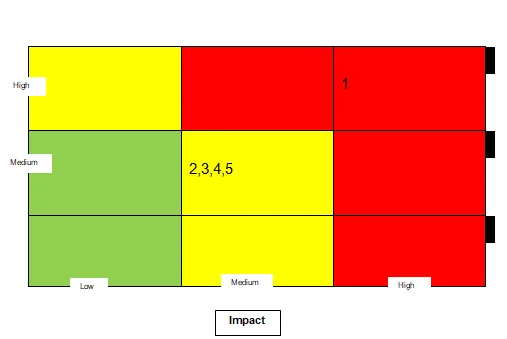
A Risk Register for Newton Whole Foods: Top 5 Project Risks, Critical Evaluation of each, Mitigation Strategies and real-world case study references. This table is consistent with risk management theory and best practice, as applied to Newton’s robotic delivery project:
| Risk No | Risk Description | Risk Category | Probability (P) | Impact (I) | Risk Rating Score | Risk Rating | Risk Effects | Risk Mitigation Actions |
| 1 | Technical failure in robots or app | Technology/IT | 4 (Likely) | 5 (Catastrophic) | 20 | Extreme | Delivery delays, loss of customer trust, disruption of service | Pre-launch testing, establishing Service Level Agreements (SLAs) with ZanderBot, backup options for delivery, continuous technical monitoring. Failure in tech integration has derailed similar projects, such as Amazon’s drone delivery issues. |
| 2 | Staff resistance and morale drop | Socio/Political | 4 (Likely) | 4 (Major) | 16 | High | Decreased morale, employee turnover, operational inefficiencies | Employee involvement in planning, clear role definitions, transparent communication, and feedback loops. Tesco’s self-checkout resistance shows the importance of managing change and ensuring employee engagement. |
| 3 | Mapping delays by ZanderBot | Schedule/External Vendor | 4 (Likely) | 4 (Major) | 16 | High | Delays in service delivery, operational downtime | Weekly progress reviews, clear milestones, continuous communication with ZanderBot to ensure timely mapping completion. Delays like those in Uber’s self-driving car testing demonstrate the operational impact of poor vendor management. |
| 4 | Budget overruns from consultant fees | Financial | 3 (Possible) | 4 (Major) | 12 | Moderate | Additional costs, project delays, unapproved budget increases | Regular budget forecasting, capped consultant costs, clear scope agreements. Airbus’s A380 delays were exacerbated by budget mismanagement and costly consultancy fees. |
| 5 | Negative public/customer reaction | Reputation/Operational | 3 (Possible) | 4 (Major) | 12 | Moderate | Loss of customer confidence, reduced brand reputation | Effective PR campaigns, clear communication about the new service, continuous customer feedback channels. Target’s expansion into Canada was impacted by poor customer reception and inadequate communication of changes. |
Risk Probability Impact Chart:
The chart below, based on ‘Probability Impact Chart,’ highlights the probability of the identified risks (risk numbers 1 to 12) occurring, and the impact of these risks. The probability and impact are expressed as low, medium or high.
Evaluation:
Rebuilding confidence requires taking a risk strategy that is proactive in nature — especially in the case of small businesses like Newton Whole Foods. Newton (early problem identification of possible risks, such as technical failure, mapping delay, staff resistance) can focus on the risk mitigation so the risks will not grow up. Hillson (2009) states that early risk identification and regular monitoring protects the project from unforeseen setbacks and enables quick adaptations, which improves the project’s resilience.
Yet, it requires to achieve the balance between planning and agility. A super-rigid, detailed plan can cause bottlenecks or slow down the decision making; a totally unstructured way may lead to inconsistency and forgetting about a mitigating risk.
For instance, Amazon’s drone project underwent frequent adaptation of its risk strategy (between regulatory hurdles and technical testing) that made innovation possible without compromising project success.
Conclusion:
The success of Newton’s robot delivery project relies on structured risk management practices like early risk identification, use of the Risk Register and continuous reviews. By dealing with potential risks in advance, Newton can be prepared for unexpected setbacks, instill trust among stakeholders and make the implementation run smoothly.
Conclusion
Finally, the Newton Whole Foods robotic delivery project is at a critical juncture where disciplined project management is required for success. The following are the most important key recommendations for Richard, the Project Sponsor, to make sure that the project achieves its objectives and brings long term value to the business.
Given the fact that overcoming internal resistance is more complicated than persuading, stakeholder engagement and structured change management are the first step towards ensuring that alignment takes place across all the levels of the organization.
As Kotter (1996) suggests, essential to successful change is inclusive communication and proactive involvement of all stakeholders, including those highly affected by new technology in their role.
Secondly, there is a need to improve Newton’s leadership behavior to build trust and buy in, which requires communicating and being emotionally intelligent. According to Goleman (1998), leaders who can change their communication style and understand their team’s concerns create a more cooperative and productive work environment.
Finally, adopting a clear and simple risk management framework, for example, use of a Risk Register and Risk Matrix will offer a structured process to identify, assess and mitigate risks. Newton should be regularly updated with this framework so that it can adapt to any new challenges.
This demonstrates how a structured risk approach is critical to success as the example of Amazon’s response to regulatory changes in its drone program shows.