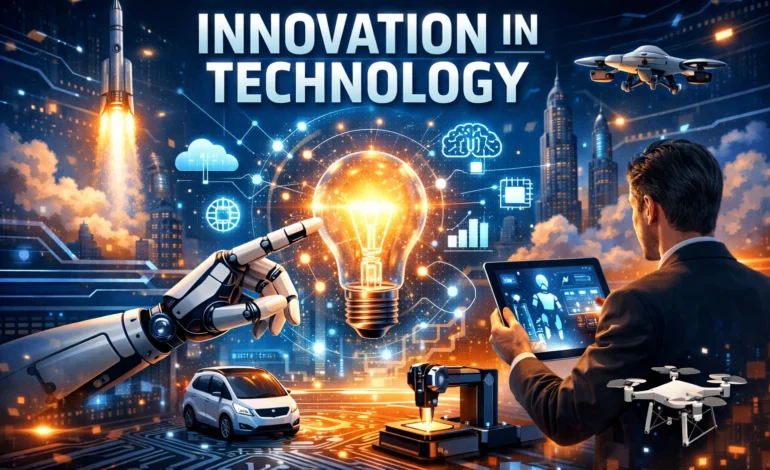
Innovation in Technology

Innovation in technology is often linked to cutting-edge developments like renewable energy or AI. Innovation is about challenging the status quo and creating revolutionary products and services that change our lives and work. Efficiency, competitiveness and market relevance are how businesses measure innovation’s impact. It could be innovative marketing strategies that disrupt markets or new business models like subscription-based services.
This context may refer to policy meetings, tech labs and boardrooms where innovation is simply assumed to be a cure for all economic as well as social problems. Innovation is described as either coming up with new things or methods, or making already existing ones more beneficial in use. This idea has many applications and interpretations.
Remember that not all innovations work as planned. Innovation is difficult, full of unknowns and failures. This doesn’t always fail in the big picture. Innovative ideas can transform knowledge and development even if they fail to catch on. They reveal what doesn’t work and why enabling.
Social innovation seeks new ways to address social issues to promote inclusion, sustainability and community benefit. To help underprivileged communities or improve society it may involve creating new healthcare, educational or social programs.
Despite the different settings all these domains share the desire to improve and do something better.
Read More: Future Technologies That Will Change the World by 2035
Section 1: The Successes of Innovation in Technology
Innovations have been the sources of some of the biggest leaps in human history. Since the invention of the wheel, for instance, each major technological advancement has been a defining moment in human history. This section will discuss three innovations namely the Internet, cellphones and vaccines which were groundbreaking in their own right. It will scrutinize what made them so effective and explore their impact on culture, economy and society at large.
Case Studies of Successful Innovations
| Cases | Impact Analysis |
| Internet It has democratized communication and knowledge on a scale never seen before, completely changing the way we access and share information. A succession of advancements in networking and digital communication characterize the evolution of the Internet, beginning with ARPANET in the late 1960s and continuing through the World Wide Web in the 1990s. | Internet Its impact is comprehensive. It has enabled e-commerce and digital economies and provided global access to information and learning resources in education. It has created new communities and social networks by changing how we communicate. It has empowered activism and democratized information politically, but misinformation and privacy concerns remain. |
| Smartphones The telecommunications landscape has been revolutionized by smartphones. Introduced in 1994, the IBM Simon was the first genuine smartphone, fusing the features of a mobile phone with a personal digital assistant. Nevertheless, the market was utterly transformed with the launch of Apple’s iPhone in 2007. Since then, smartphones have exploded in popularity, serving as a one-stop shop for all things related to communication, entertainment and wor. | Smartphones Their widespread use has changed daily life. They have revolutionized media consumption, made global communication affordable and become a primary information source. The smartphone-based app economy has created millions of jobs and new industries like mobile gaming and on-demand services. |
| Vaccines Among the most groundbreaking medical advancements, vaccines have prevented the spread of diseases like polox and COVID-19. Many regions of the globe were able to eradicate polio thanks to the vaccine that Jonas Salk and Albert Sabin created in the 1950s. A more recent example of how modern medical science can respond quickly to global health crises is the rapid development of vaccines against COVID-19. This was made possible by groundbreaking mRNA technology. | Vaccines Public health has benefited greatly from vaccines. The polio vaccine nearly eradicated a disease that terrified and disabled people. Rapid vaccine development and deployment have saved countless lives, demonstrating the power of international collaboration and innovation in a global health emergency. |
Factors Leading to Success
These innovations have succeeded due to several factors:
Internet, smartphones and vaccines met fundamental human needs. Their direct impact on life quality contributed to their success.
Related technology breakthroughs were crucial. The Internet benefited from computing and telecommunications advances. Smartphones used touch screen technology and component miniaturization. In vaccines, molecular biology and immunology advanced
These innovations were widely adopted due to their accessibility and usability. The Web’s user-friendliness, smartphones’ intuitive interface and vaccines’ efficacy made these innovations accessible to a wide audience.
Each innovation thrived. The Internet grew within academic and research institutions. The smartphone industry benefited from app growth and mobile network improvements. Global cooperation and public health initiatives helped vaccines.
Innovation timing was crucial. They emerged when the market and society were ready for change and complementary technologies and infrastructures supported their adoption and growth.
These case studies show how successful innovations can transform society, the economy and culture. They stress the importance of meeting basic needs, using technology, ensuring accessibility, creating supportive ecosystems and timing market entry. Combining these factors creates transformative and lasting innovation.
Section 2: The Other Side – When Innovations Fail
The tale of innovation is not necessarily one of resounding success. We learn a lot about the challenges of market acceptance and technology implementation from the many ambitious projects that fail. Here we take a look at three well-known innovations that didn’t pan out: Google Glass, Segway and New Coke.
| Cases | Analysis Impact |
| Google Glass In 2013, after years of expecting, Google launched Glass – one of the biggest leaps in the developing wearable tech field. Everyone predicted that it will alter how we are going to use the digital information – it is a small mounted HMD, taking images and videos as well as connected onto the wired network. | Google Glass Users would worry for their privacy after they learned that these glasses can make an unseen recording on videos. It did not take long before they became the target of enmity or suspicion whenever they went out in public. There were many who considered the Google Glasses design intrusive and technologically-too-involved. However, it was not fashionable and its awkward social behavior reduced its attractiveness to be used on a daily basis. However, despite its stylish futuristic characteristics, it did not resolve a specific problem. It was not a technological wonder that sought to solve any problem. |
| Segway At its introduction into the market in 2001, the Segway Personal Transporter was regarded as the latest invention in personal transportation. It had autonomy and was electric to be a game changer in inner-city transportation. | Segway The Segway suffered major regulatory challenges. Numerous cities put bans or restrictions on this “grey-area” transportation device because of its ambiguous status. At face value, the Segway could not work within urban environments. This was not as flexible it should have been because it weighed more and was slower compared to projections. Segway was even termed as the new way of transportation and as such it was sold at a very high price that many people could not afford. Law enforcement and tourism were its niche markets but had moderate success. |
| Coke Introduced in 1985, New Coke was the result of Coca-Cola’s decision to alter its century-old secret recipe. Market research and taste tests indicated that a sweeter formula would be more popular, so that’s what they used to make the decision. | Coke The brand lacked acknowledgment of how closely attached their custom were to the original Coke. A lot of people felt that this update dishonored a popular product. Taste tests leading to the making of new coat failed to incorporate emotional and brand loyalty considerations. The initial recipe was closely linked to a customer’s feelings about themselves and memory. The revelation of New Coke culminated in a public relations catastrophe that ruined general consumer trust and credibility of the product’s name. |
Positive Outcomes of Failures
These innovations offered important insights despite their flaws:
Google Glass
- Google Glass’s failure highlighted key elements of wearable technology, including discreet design, clear functionality and privacy concerns, paving the way for future Wearables.
- After failing in the public market, Google Glass shifted to industrial and medical applications, where its hands-free information access is valuable.
Segway
- Segway technology inspired the development of personal electric transportation like electric scooters and hover boards.
- Segway’s failure highlighted the need for innovative urban transportation solutions, influencing future developments in this sector.
Coke
- Coke failure highlighted the significance of brand identity and customer loyalty. When the original formula returned as Coca-Cola Classic, sales soared.
- Coke exemplifies consumer behavior and market research complexity, educating marketers on consumer preferences and brand attachment.
Section 3: The Learning Curve in Innovation
Innovation breakthroughs, successes, and failures create greatness. Understanding innovation failure is essential to understanding breakthrough inventions and advances. Thomas Edison’s light bulb invention shows how innovators learn from failure.
| The Role of Failure in Innovation Failure is essential to innovation. By trying different things repeatedly with a hypothesis one can achieve most revolutionary results. As important as knowing what works is knowing what fails. A refinement of an idea into a workable solution requires eliminating unnecessary elements. Failure is a common occurrence in innovation, but it’s a step towards success after recognizing the lessons. Failure is among the attributes of successful innovators. Failure is a part of that learning process for them – not an insurmountable obstacle. In fact, many successful innovations begun as failure. | Case study: Thomas Edison and the Light Bulb The light bulb was invented by Thomas Edison after a series of failures. The search for a practical electric light lasting indefinitely by Edison was not easy. Over and over again he tested thousands of filament materials, but every time they were unsuitable for the purpose. His famous saying, “I succeeded. Innovation is represented in the phrase “I found 10,000 ways that won’t work,” However, through numerous setbacks, it was finally discovered by Edison that one could sustain a candle for around 1,200 hours using a carbonized bamboo filament. The modern electric light bulb dated back to 1880, and revolutionized how people lived at night at home and on the streets. His determination and ability to learn were lessons from failure, which enabled him to be successful. |
Learning from Failure
Innovative leaders like Edison show how companies and individuals can learn from failure:
Encouragement of Experimentation
Innovative companies encourage risk-taking and experimentation. They accept failure and create safe spaces for learning and testing new ideas.
Learning and Adapting
Successful innovators learn from mistakes. They assess the failure, adjust their strategy and apply these lessons to future projects. Innovation is unpredictable, so adaptability is essential.
Pivoting Strategies
Successful companies have learned from failures and pivoted their strategies. Some tech companies pivot after failing in one market segment to succeed in another. Be flexible and willing to change course when needed.
Understanding Market Needs Better
Failures often show that the innovation doesn’t meet market expectations. Successful companies use these failures to better understand their target audience and improve their products and services.
Promoting Continuous Improvement
Failures teach continuous improvement. Failure-learning innovators never settle for the status quo and always seek improvement. This relentless pursuit of excellence drives innovation.
Failure is essential to innovation. Creating something new often involves setbacks and obstacles. However, these challenges reveal innovation’s true value. Innovators must accept failure. It underpins learning, adapting, and succeeding. Innovators like Thomas Edison show us that failure is often the path to success.
Section 4: Long-term Impact of Failed Innovations
Although short-term gains are commonly used to gauge an innovation’s success, the real measure of an idea’s influence is often only apparent in retrospect, especially when thinking about the knock-on effects of failed attempts. Here we take a look at the larger cultural and social effects of some innovations that didn’t quite work out, such as how they changed people’s views or paved the way for future research.
Off-Shore Achievements
While Google Glass was ultimately unsuccessful in the consumer market, it was instrumental in the advancement of AR technology. Google Glass’s development was pivotal in the advancement of augmented reality because it pushed the limits of miniaturization and integration of complicated components. While most of the infrastructure for augmented reality was built for Google Glass, its use has since expanded to other domains, including gaming, education and industry.
The first generation of electric vehicles didn’t catch on because of issues with battery technology and the popularity of gas-powered vehicles. Nonetheless, the groundwork for the current electric vehicle revolution was laid by these pioneering models. They were instrumental in the early days of electric propulsion and helped develop crucial parts that modern EVs rely on.
Despite being a symbol of high-speed air travel, the Concorde’s high operational costs and limited route viability led to its commercial failure. But the Concorde’s technological and engineering advancements have changed the face of aviation forever. Improved and quicker aircraft have resulted from their work in the fields of aerodynamics, materials science and jet engine design.
Cultural and Social Impact
When new ideas do not work, then usually other people start questioning the status quo. One example of this is the debacles associated with Segway’s as a personal transportation device which made designers and marketers reevaluate their assumptions about urban mobility and consumer tastes. Similarly, marketers learned much more about how consumers react to brands and how they behave when New Coke was rejected, making them more aware that consumer products are cultural-emotive objects.
At the same time, failures can be used as stepping stones to explore new research avenues. In response to difficulties encountered in developing first generation renewable energy sources like wind turbines and solar panels there should be considerable investment in energy storage and materials science. This led to increased funding and research efforts in these fields leading to renewable energy technologies that were not only more efficient but also cheaper.
The lessons and ideas learned from failed innovations can become valuable assets for those planning to introduce successful new products or services in the future. One way of avoiding the same mistakes is through reflecting on past experiences thus finding new paths for innovation
Most of the voice assistants that are AI driven today have been influenced by some mistakes in the past.
Government policies and regulations can be shaped by new ideas that do not work out. Initially, in response to early autonomous vehicle safety concerns, stricter regulations and standards have improved safety and reliability for self-driving car development and testing.
There is a long cultural tradition of recounting failed inventions as testaments to human ambition and perseverance or examples of what not to do. This has influenced how technology is seen in popular culture. We should therefore be cautious and thoroughly test any new technology due to the Hindenburg airship disaster which stands as an emblem of the perils inherent in technological innovation.
The consequences of failed innovations are long term. These attempts may not bear immediate fruits but they largely lay the foundation for future successes, change societal and cultural perspective, and open up new avenues for knowledge and discovery. They show that progress is non-linear; something bad can become something good. Only when people understand this aspect of innovation will they be able to fully appreciate human creativity and advancement.
Conclusion
This report has travelled the complex world of innovation, looking at both its lauded achievements and its frequently neglected setbacks. These revolutionary inventions that we mentioned include internet, cellphone and polio/COVID-19 vaccine. It demonstrated how a successful innovation changes a society, its culture, and the economy as a result of market timing, meeting the necessities, and technological advancement.
Then again, ventured into the territory of abortive inventions having a look at cases such as Segway, Google Glass, and New Coke. Some of the causes that explain why innovations fail include market timing, customers’ expectations and technological barriers; these occurrences illuminate their reasons. However, it was discussed on how these bumps are not the end of the way, but chances for us to learn other things that could lead to success.
However, when it came to the role of failure in innovating, a case study that came to mind was that of Thomas Edison’s attempts at inventing the light bulb. This case study emphasized on persistence, adaptability and being open to feedback while pursuing game-changing innovation.
Finally, examined how previous failures have impacted societies and cultures throughout history and how they opened up doors for other discoveries and further studies.
This thorough analysis provides support for the argument that a given innovation’s success cannot be judged on its initial performance. Rather consider an approach to innovation that gives account of cumulative or indirect influences on learning and improved productivity. Innovation is not complete without successes and failures, which are important teachers and providers of opportunities.
To understand dual characteristics of innovation that can lead into success or failure is important as this may guide future approaches in various areas. Acknowledging that there will always be set-backs along with the innovation process develops an attitude of being resilient and adaptable. In order for an organization to be successful in an evolving environment, individuals should have a readiness for ongoing learning and the capacity to try new things.
This is an understanding which enables one to adjust readily or make alterations where necessary. Such an approach has ability to influence upon scientific-technological communities in becoming generous with their developmental testing of R&D, trials, and errors. This can inform curriculum and policy frameworks that encourage creative problem-solving and critical thinking.
This is a complex understanding of innovations that could determine any success in conquering 21st-century challenges. This approach towards innovation will enable organizations and individuals to learn from errors they made in the past and therefore, consider taking calculated risks in the future. Accepting innovation means being realistic, using our human ability to be creative, and improving even in our victories or defeats in our persistent journey forward.