
Business Project of Pizza Hut UK

This report, “Business Project of Pizza Hut UK,” aims to demonstrate that Pizza Hut UK has played an essential role in the growth and variety of the business throughout the years. It has become the biggest franchiser of the famous American brand in the UK, with 152 sites and 4,000 employees, and has established a strong presence there.
With its prominent position in the market, Pizza Hut UK represents more than just food supply; it is an integral part of the thriving UK hospitality and service sector.
However, recent developments have dampened its future potential. Pizza Hut’s UK location is facing a lot of problems, including mounting debt, rapidly expanding expenses, and the risk of loan agreement violations. A number of larger economic issues, including the post-epidemic recovery phase, inflationary tendencies, and an unpredictable energy market, contribute to these problems.
This article will give a comprehensive examination of these challenges and suggestions for strategic action afterward. We will look into issues both now and in the future, as well as the effects these difficulties will have on different groups of people.
Challenges / Problems the Client is facing: Business Project of Pizza Hut UK
Existing Issues
The current financial status of Pizza Hut UK, which is defined by a debt of £73 million, of which £31 million requires immediate refinancing, is one of the most serious challenges that the company is now facing with its finances. It was further exacerbated by the crisis in Ukraine, which led to an unusual spike in the prices of energy, food, and transportation.
The aftermath of the epidemic brought about a lasting impact, which was further exacerbated by the situation in Ukraine. Particularly noteworthy is the fact that the cost of electricity reached its highest point at around twelve times the average price throughout history, while the rate of inflation for food prices climbed drastically.
Due to these circumstances, the company has been obliged to incur an operational loss, despite the fact that there has been an increase in sales. Additionally, there has been a lack of suitable personnel, and there has been an increase in the demands and expectations regarding salaries.
Potential Future Problems
With an eye on the future, Pizza Hut UK is confronted with the possibility of ongoing economic instability. Persistent inflation may have an impact on both the costs of operations and the purchasing power of consumers. It is possible that disruptions in the supply chain could further increase prices and hinder efficiency.
Additionally, changes in customer behavior, maybe toward more cost-effective dining options or choices that are more health-conscious, could have an influence on the demand for Pizza Hut’s products and services or services.
Purpose of the Report
By providing strategic counsel, the purpose of this research is to help Pizza Hut UK prepare for future market uncertainty and minimize the current financial issues that the company is facing. This paper attempts to offer insights that will secure the long-term viability and success of the organization by making use of an analysis of the existing and anticipated market conditions.
Additionally, taking into account emerging market trends and consumer behaviors, the recommendations will be based on the realities that are currently in place.
Impact of Research on Stakeholders
Identify Stakeholders
Internal Stakeholders: Employees, Management, Shareholders.
External Stakeholders: Customers, Suppliers, Creditors.
Connection to Stakeholders
Pizza Hut UK is now dealing with a number of operational and financial challenges, and these issues have an effect on each and every stakeholder group, either directly or indirectly. As a result of the restructuring of the company’s finances, it is possible that employees will suffer changes in their working conditions as well as changes in their job security. In the midst of these turbulent conditions, the management of the company and the investors are burdened with the responsibility of managing the delicate balance between ensuring the company’s survival in the short term and expanding it over the long term.
We reserve the right to make adjustments to the items on the menu, as well as the prices and the level of service that we provide. If the company is unable to pay its debts and satisfy the demand for its goods or services, the creditors and suppliers of the company would be the ones who would be impacted.
Impact on Stakeholders
Because of the current challenges, any modification to the strategy or policy will result in a domino effect because of the current situation. In order to accomplish the goal of improving financial stability, which may protect employment and shareholder value, it may be essential to make difficult decisions, such as reorganization or cost reduction.
There is a possibility that menu prices will be raised in order to address issues regarding revenue. Nevertheless, this may discourage customers who are price-conscious. Every strategy that is being suggested needs to give careful consideration to these ramifications to achieve a balance between securing the future of the firm and protecting the interests of stakeholders.
Power interest matrix
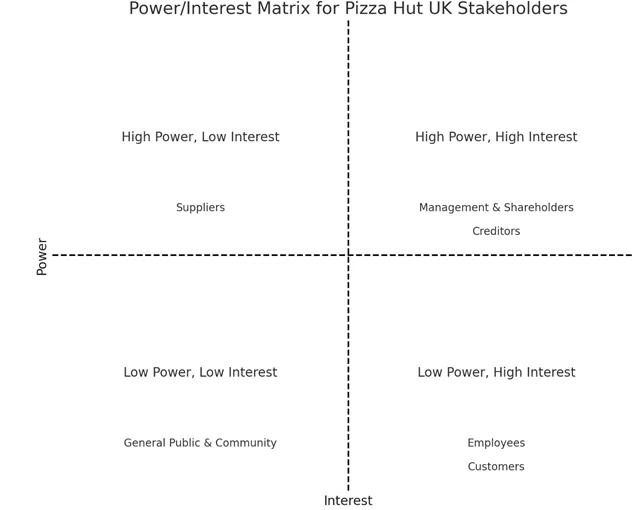
In Pizza Hut UK, the Power Interest Matrix is a useful strategy tool that can be used to identify and classify stakeholders according to the level of power and interest they possess. “Low Power, High Interest” encompasses Employees and Customers, who need to be informed to maintain morale and loyalty; “High Power, Low Interest” involves Suppliers, who require satisfaction and stable relations “Low Power, Low Interest” involves the General Public and Community, who are monitored to ensure positive public perception and responsible business practices by ensuring that they are properly informed.
Considering the huge influence and entrenched interests that these four organizations possess, they are actively participating in the matrix. By gaining an understanding of the positioning of its stakeholders. Pizza Hut UK is able to bring its business practices into alignment with the requirements and expectations of each stakeholder group, as well as ensure that all groups are effectively considered in the decision-making processes.