

Global Strategy and Implementation of Nestlé.

This report “Global Strategy and Implementation of Nestlé” aims, Nestlé, the renowned global company in the food and confectionery products industry, has its tentacles spanning across 186 countries. The array of products includes household brands that are recognized globally. In the present day, Nestlé generated a turnover of more than $111.03 billion by which they are supporting 270,000 employees around the globe. The company’s variety of Nestlé products, from Nutrition and wellness to indulgence, is intended to meet the complete requirements of consumers, and their product delivery is always excellent and innovative. Being one of the main pillars of the industry, Nestlé is by all means a contender for a wider reach and a long-term impact, as it not only pursues product development but also promotes life enhancement by means of health and sustainability.
Read more: Global Strategy and Implementation of Coca-Cola.
Threat of Substitutes
Health and Wellness Segment
The shift in consumer choices from the traditional consumption of fast foods to healthier options such as organic and plant foods has witnessed a tremendous increase. An increasing number of new alternatives to the traditional highly processed foods present themselves as more natural, more environmental and health-minded options. Nestlé which is a market leader has done the same as the other major players by expanding their range to include organic and plant-based alternatives ignoring its own competition to capture the growing market segment and control the threats posed by the substitutes.
Private Label Products
The times of recession or financial austerity rates usually shift the customers’ interest to more budgetary options. The private label products provided by the retailers represent an alternative source which is such sometimes, at much reduced prices than branded products. About brands like Nestle, these threats are unnerving since cost-awareness in customers can outweigh brand loyalty during tightening budgets.
Consumer Trends towards Homemade Meals
The growing tendency towards home meals ready and be done from a scratch is a clear illustration of the changing mindset of consumers regarding the quality, freshness, and tailor-made food. This implies that the demand for these companies’ products is reduced as people prefer the unpackaged and freshly made food, moreover, these are companies like Nestle, which offers these kinds of packaged and processed foods. In order to tackle this challenge, Nestle can venture into the realm of partnerships and acquisitions within the sector of fresh foods and meal kits, providing customers with tailored solutions that can be easily accessed for their evolving food palette.
Technological Advancements
Continual innovative technologies can create ways for new types of trade to be established. Take, for instance, the appearance of lab-grown meat and the alternative sweeteners that are among those that could replace the existing ones and structure. Nestle should continue watching closely and spend on research and development to keep on top of the yearly developments. Moreover, the company can use the same technologies to develop some unforeseen products that will suit the changing consumers lifestyles.
Changes in Lifestyle and Dietary Habits
Lifestyle changes, relating to health or ethics, the consequence of increased awareness, impact consumer tastes by furthering choice of substitutes. The likes of Nestle will need to exhibit flexibility and something closer to agility as the consumer landscape keeps on shifting, which could be in the form of a wider portfolio that leverages on trends like sustainable supply chains and ethically produced products.
Competitive Rivalry
Intensity of Competition
The food and beverage industry is an epic back-to-back struggle with lots of international and regional players containing each other. The competition would use different product categories for instance drinks, snacks, dairy, and candy products. Today, Nestle is in a head-to-head struggle with the titanic rivals as Unilever, PepsiCo and the infamous Coca-Cola as well as with the small sharks which specialize on specific consumer segments or narrow market segments.
Importance of Innovation
Thus competition breeds innovations, as a continuing trait from migration. It also incorporates market planning for services such as product development as well as marketing strategies, distribution channels and packaging innovation.
As a way to push pharma making, nestle invested much on research and development to make new forms, to enhance the existing ones and to achieve the updated knowledge of consumer trends. Besides, alliances with competitors or takeovers could bring into the technology companies the innovation or those segments of the markets particular to them.
Price Wars and Promotional Activities
The industry is plagued with price wars and promotional activities like discounts, vouchers, and bundled offers mostly during times of economic instability and at the time of new launches.
Nestle always finds a way to keep their prices at competitive level by using their scale and efficiency and their customers still continue to get value for money.
Differentiation Strategies
In the environment of fierce competition, differentiation by means of branding, product quality, and customer experience is of vital importance. Creating a powerful brand identity, highlighting product features such as flavor, health, or environmental friendliness, and delivering outstanding service can differentiate firms in a crowded market.
Nestle who concentrate on building unique value propositions for the company’s brands and using her image of quality and innovation to make her stand apart her competitors and improving customer loyalty.
Global Market Dynamics
Globalization has increased competition as it allows companies to access wider markets and most of all, it exposes them to stiff competition both from local and foreigners. The global dimension of Nestle’s operations offer both opportunities and risks, necessitating local adjustment of the company’s strategies, but also to use its scale and resources to successfully compete in the global arena.
Reasons for Attractiveness
- The amazing competitiveness on the market can’t reduce Nestlé’s strong brand reputation and the variety of its products, which is a guarantee for the company to allow it to still hold a competitive edge.
- A degree of supplier power allows Nestlé to bargain for terms and condition that outbalances their suppliers and thus, sustaining the supply chain.
- The easy price fluctuation based on the moderate power of clients can help the company in terms of profitability by aligning it with the brand name that make the company famous all around the world.
- Substitutes are obviously a problem for Nestlé but due to fact that this corporation aspires to be as innovative as possible as well as to adapt to the ever changing consumer preferences means that the company is going to benefit a lot from these emerging trends that could be detrimental to other companies.
Analysis
Nestlé managed to apply both Porter’s Diamond model and Bartlett & Ghoshal’s framework as its international strategy.
Porter’s Diamond Model
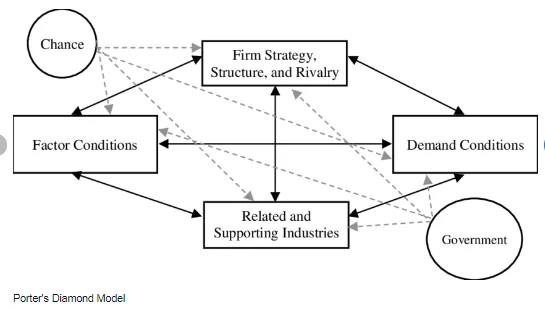
Factor Conditions
As Nestlé is greatly supported by Switzerland’s sound factor conditions that create favorable grounds for its sustainable development, its subsidiary companies effectively conduct their global initiatives. Switzerland benefits from a strong labor force which is distinguished in many aspects:
designing, engineering, and marketing to name just a few. Such a high-skilled workforce provides Nestlé with a productive base for its commitment to the production of the best quality and innovation in the plethora of their product offerings. Furthermore, its technology is superior in the country that comprises of modern research laboratories, transport routes, and distribution centers which support the Nestlé’s production processes and product circulation.
Furthermore, Switzerland, which is home to stable government and low corruption, is widely recognized as a good place to do business due to all aspects that involve political and economic environment. The dimensions of low risk create a sense of security, which enables Nestlé to engage in long-term research and development projects and thus bring about continuous product innovation.
Demand Conditions
Nestlé performs at the dynamic world market as demand conditions are differentiated but are influenced by cultural habits, economic development, social dynamic and life trends. At the same time, there is a growing trend among developed markets such as Europe and North America where people become more health and wellness conscious, and ethical sourcing of products is becoming an important factor in consumer purchases. Nestlé responds to such preferences by providing a comprehensive variety of alternatives to the unhealthiest products such as organic snacks, plant-based drinks, and the goodies enriched with useful components and foodstuff.
On one hand, for example, in emerging countries like China, India, and Brazil, where consumers mostly demand affordability and accessibility, those consumers tend to be the majority in those countries. In order to distinctively target different markets, Nestlé modifies its assortment and price policy offering seemingly affordable options in smaller packages sizes and in some cases investing in distribution networks to service remote areas.
Related and Supporting Industries
Switzerland and its reputation as the leading food and beverage market provide Nestlé with a great chance of effective company’s development through presence at the industry cluster that is of crucial to Nestlé. Yet, the country is a homeland of many suppliers of raw materials, packaging materials, and the cutting- edge technologies, so that these ecosystems promote innovation and the formation of collaborating circles. Nestle uses these industries of agribusiness, packaging, and other technologies for the sourcing of high quality ingredients, sustainable packaging solutions, and innovative technologies that provide not only safe and high-quality products but also eco-sustainability.
Moreover, Switzerland operates a wide range of significant research institutions, e.g. universities and scientific research organizations, which explore emerging technologies and come up with new knowledge in the food industry. Nestlé boosts the research and development, the exploration of new ingredients and formulations in close cooperation with these institutions. In addition, they also consider emerging consumer trends and try to determine tastes for new products altogether.
Firm Strategy, Structure, and Rivalry
Nestlé Company’s strategic plan focuses on the innovation of new products, positioning already recognized brands, and process oriented management using a decentralized organization structure. Through innovate ideas, the organization acts to get local people involved and spread autonomy in the regions. This gives the companies an advantage in responding to market and consumer changes, as the local teams respond faster. The network organization of this company drives the flexibility and agility that allows Nestlé to customize its range of products and marketing activities to match the tastes and potentials of the markets where it operates.
Further, cutthroat competition in the food and beverage market force a need for Nestlé to always carry out innovations plus offer products that are uniquely different to the competitions to remain ahead of the pack. By allocating significant resources to innovation, promotion, and brands building, the company looks to fortify its market position mutually and neutralize potential threats posed by competitors. Furthermore, partnerships, acquisitions, and alliances are crucial components of the growth strategy of Nestlé which in turn propels the company to not only create a comprehensive product portfolio but also captures new market areas and capitalize on upcoming opportunities.
Chance
The global market within which Nestlé operates is which is rather diverse, composed of ever changing consumer preferences informed by cultural customs, economic development and social dynamics.
The emerging trends like strengthening health and wellness awareness and ethical sourcing issues offer many opportunities for Nestlé to change and innovate.
Increased health-consciousness among the consumers and necessity of healthier alternatives and ethically sourced products will enable Nestlé to diversify its product portfolio taking into account the new consumer needs.
Government
Switzerland is a country with stable government, and low level of corruption, which makes its a good place for companies like Nestlé to set up their operations. The stable political climate provides confidence and predictability for long-term investments where Nestlé can undertake research and development projects and continuous product innovation without doubt. Low political risk boosts Nestlé’s capacity to develop and implement sustainable growth strategies, as the firm is able to pump money into innovation and expansion projects without worrying about political instability or sudden policy adjustments.
Bartlett & Ghoshal’s Framework
Export Strategy to Multidomestic Orientation
Historical Reliance on Export Strategies
To begin with, some of the corporations in the food and beverages sector, including Nestle, were majorly based on export strategies in relation to market penetration in foreign states. Thus, they were able to launch the business without a massive local office infrastructure that would normally be present.
Exporting enabled Nestle to be the first to introduce its brands in international markets, have opportunities in understanding the needs of the market in addition to the demand without the high investment cost of manufacturing or distribution networks in the location of the target market.
Transition towards Multidomestic Orientation
With Nestle growing its strength in the global market, it was uncovered that it should adjust its marketing strategy to present its products amid several cultural differences and preferences in the market.
This adjustment to a multidomestic orientation illustrates the industry’s conviction to satisfy local taste and preferences, which they believe locally relevant will help to sustain completion and relevancy across the world market.
Acknowledgment of Local Market Importance
Nestle’s lifeblood as a multinational company lies in its locally tailored orientation to the market in which it operates; hence the sense of the local market drivers of business growth and ultimate success.
Nestle takes steps to linking marketing strategies to the local consumer’s preferences, as a result it supports its brand positioning and promotes the consumer connection in the whole world, no matter the region.
Global Strategy
Utilization of Global Elements for Efficiency
Adopting a multi-domestic orientation, firms such as Nestle however still utilize some aspects of a global strategy in order to exploit the economies of scale, and for improving operational efficiency.
Standardization of processes and products is an essential factor in accomplishing the productivity and cost objectives. Nestle installs quality control systems in all its manufacturing units across the globe to provide a consistent quality of products and to meet the statutory requirements.
Centralization for Supply Chain Efficiency
When some supply chain processes are centralized, nestle can make the operations simple, reduce overhead costs and improve efficiency.
Centralizing some of the key functions can help Nestle use its global resources efficiently, speed up the process of innovation, and respond quickly to the market requirements that lead to its competitive advantage among others in the industry.
Transnational Strategy
Balancing Global Integration with Local Responsiveness
Nestle transnational strategy is to find an equilibrium between global integration and local responsiveness that enables it to operate successfully in different and dynamic markets.
Nestle will focus on exploiting opportunities that arise by using both direct and indirect ways of engagement into the global and local activation as well as distinctive local market peculiarities and preferences.
This strategy strives to instill uniformity in branding across the world provided that the products and services offered reflect the unique tastes of the different local markets which increases the likelihood of remaining relevant and appetizing to the global consumers.
Multidomestic Strategy
Subsidiaries’ Ownership of Its Branches for Subsidiaries Performance.
As opposed to this, Nestle’s multidomestic strategy that is installed and supervised by the Subsidiaries in each country is responsible for the creation of products and strategies that are the best solution tailored to each patient’s needs.
The decentralized scheme of decision-making authority makes possible the teams of Nestle in the areas to respond quickly to the shifts in the market environment, consumer tastes, and regulations.
This local orientation is infinite in diversity as well as in plural of ideas, cultures and local entrepreneurialism which help Nestle to maintain its competitiveness and the ability to adapt to varied but related demands in all the global markets.
Implication of Current Environment
PESL Analysis
Analyzing the external environment using the PESL framework (Political, Economic, Social, and Legal factors) can provide insights into the challenges that may affect Nestlé’s competitive position:
Political Factors Regulatory Environment:
Nestlé operates around the world and there are various regulations that every country has in place, this covers the food and beverage industries. The rising demand for higher health and safety criteria, the mandatory labeling and the advertising restrictions are the sources of the challenges for Nestlé. The compliance and adjustment to various standards are enormously oppressive.
- Trade Policies: A change of international protocols, for instance, tariffs and trade agreements, can undermine the Nestlé supply chain and reach the market. The impeding of trade by disputes and protectionism measures can obstruct or alter the circulation of raw materials and products, to which Nestlé reacts with changes in its cost base and in its competitive capacity in the international markets.
Economic Factors
- Inflation and Currency Fluctuations: Nestlé’s manufacturing processes, consumer market demands, and global transport systems make it vulnerable to foreign exchange rate fluctuations and changes in inflation in major markets. This volatility can lead to shifting in company’s revenue and profit margins to other regions where these numbers are considerably higher compared to where the majority of the sales take place.
- Consumer Spending: Such situations as economic downturns or recessions can lead to decrease purchase of the products based on personal preferences (discretional products), which will affect into the sales of Nestle. Unstable economic environment, in turn, might lead a customer to look for cheaper variants of products thus affecting Nestlé’s pricing and product mix policies.
Social Factors
- Changing Consumer Preferences: A trend of consumers seeking out healthier, sustainable, and fair trade items not only presents new opportunities but also threats to Nestlé. Making the way for the unending consumer needs calls for continual innovative solutions and their application to increase the value of the offered products, which might entail huge amounts of time and resources invested in R&D..
- Health and Wellness Trends: The increasing health and fitness problems plague society today, including overweight and chronic health problems. The health-conscious young generation emerging due to this is also fueling the demand for healthier food and drinks. Nestlé is forced to reposition its product recipes, while decreasing in the sugar, salt and fat content and delivering more accurate nutritional information in order to avoid criticism from the customers and meet the regulatory standards.
Legal Factors
- Food Safety Regulations: Strict Food Safety Regulatory Requirements Force Nestle to comply with the Tight and stringent regulations, send them to ingredients and raw materials sources, manufacturing process and product distribution through facilitating distribution channels. Nestlé living Nestlé’s values of quality and innovation cannot be undermined by any non-compliance with regulations or recall of products which may damage Nestlé reputation and customer loyalty.
- Intellectual Property Protection: The protection of intellectual property rights being upheld is a fundamental factor for Nestlé for it needs to keep its brand names, patents and trade secrets unattainable to fraudulent imitation and counterfeiting. I would highlight the legal obstacles on intellectual property claims as being very costly and voluminous in both time and finances, increasing the risk of Nestlé falling behind in competition.
The external environment presents several challenges that could affect Nestlé’s competitive position:
- Complying with and dealing with issues related to numerous local regulatory systems and international trade regulations that might differ from market to market.
- Managing currency exchange rates through preference for local exports and the inflationary pressures on its costs and pricing.
- Catering to developing shopping patterns modifying towards healthier, responsible lifestyles and ethical delivery.
- Adhering to a rigid set of food security regulations and preventing intrusion into intellectual property rights.
- Proceeding through the economic fails and fluctuations of the consumption’s expenditure.
Trying to maintain a desired level of innovation and investment into research and development powered by mentioned market changes.
CSR Practices
For Nestlé, commitment to CSR underpins the code of ethical conduct as well as business aligned with UN SDGs. The company focuses on various areas to drive positive impact, including:
Sustainable sourcing: Nestle encourages responsible sourcing of those raw beverages (cocoa, coffee, and palm oil) which resource the nearby sites to the benefit of the local people and ecosystems.
Environmental sustainability: Nestlé will exert its effort on decreasing environmental imprint by the placement of water and energy-saving measures, decrease of wasting, and renewable energy sources investments.
Nutrition and wellness: The Company Nestle should commit to the physical quality of their products also by adding detailed labels and educating and providing people with information about good health using the health programs.
Community engagement: The Company engages a local population via activities like building capacities, health programs and support to young generation with the purpose of empowerment and the disadvantageous group up liftment.
Nestlé, likewise, has plugged in CSR practices into its business functions and prominently helps the UN SDGs to be achieved. This shows that the brand is socially responsible and development toward sustainability.
Recommendations
- Differentiated Product Offerings: Nestle can secure its competitive edge by constantly striving to innovate and produce various products, which this distinct aesthetics imply, and which tend to go well with the given culture and preferences. This kind of game plan enables Nestlé to address the needs of various groups of consumers while at the same time to use global distribution and mass production at its disposal.
- Localized Marketing and Branding: Use of localized marketing, creative and identifying your brand with your target market will make you not only be heard, but also be felt. Immersion into the local country culture is a tool that enables Nestle to increase its brand image by developing bonds with the consumers, thus leading to their loyalty and driving penetration into the market.
- Strategic Partnerships: Through cooperation with local stakeholders, the representatives of which are governments, NGOs and community associations, the problems are being sorted out much more quickly and efficiently. Through the building of networking the Nestle can engage more to social performance and help United Nations’ goals and will additionally gain trust and credit within native communities.
- Leadership and Cultural Sensitivity: Nestlé’s leadership should cover cultural sensitivity and diversity as there are many differences within different group of people as well as the fact that companies of these type of companies are all cross-cultural and how can they communicate effectively.